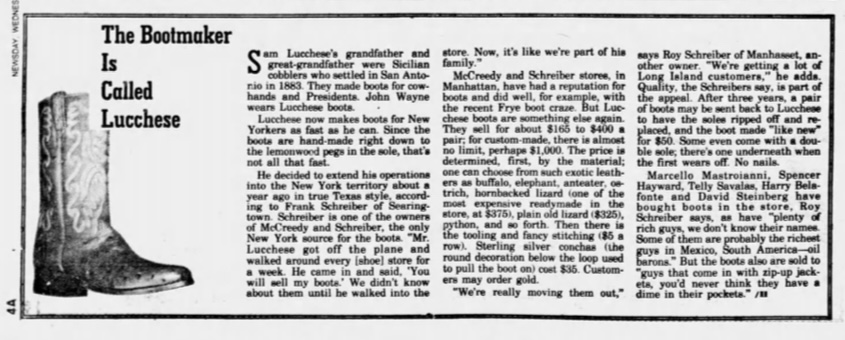
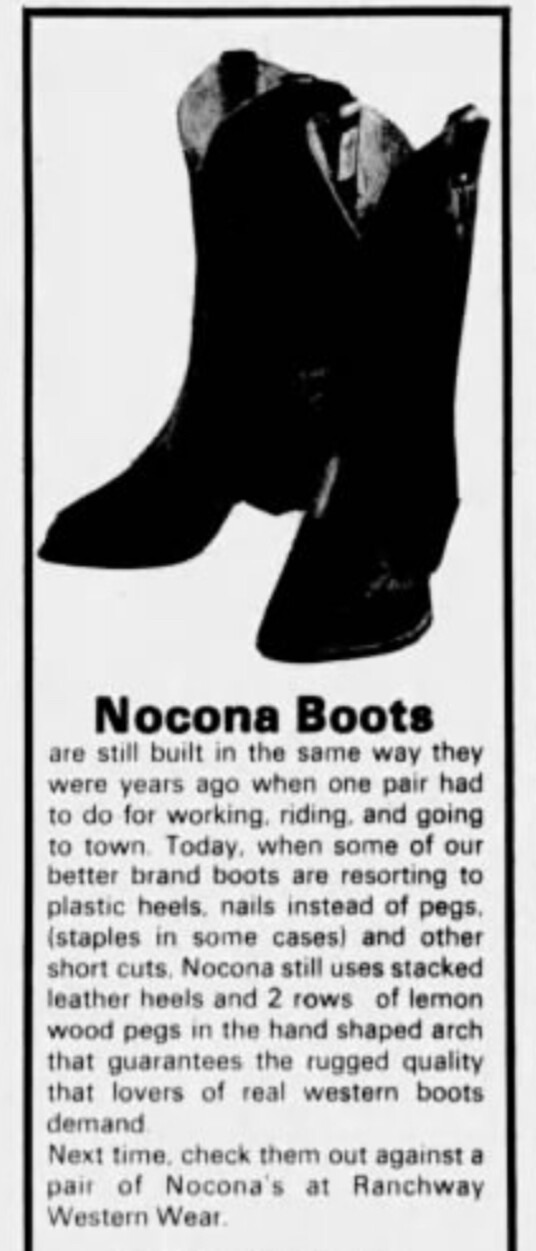
Checked newspaper archives, nothing before 76 but ads from Lucchese in 77, Nocona in 76, and Dan Post in 78 with the term, as if on cue. I wonder if there was some concerted trade wide effort at the time to push a new buzzword or if it was truly viral and they were copying eachother.

1 Like
Nice research! I knew the phrase started sometime in the late 70s or early 80s. Someone made up the phrase “lemonwood pegs” around that time and for some reason it caught on. I’ve heard of vintage pegs made of maple; I have a newspaper article from 1939 confirming they’re birch. There’s no mention of “lemonwood” for years and years and years.
I talked to BlauRing and they used to sulfurize their pegs to make them whiter. Perhaps when they stopped someone saw the yellow and called it “lemon” as a color descriptor instead of a wood descriptor.
1 Like
What’s odd is that many bootmakers continue to insist they use lemonwood pegs. Luchese mentions it repeatedly on their website. So does Mandujano, Rod Patrick, Chisos, and many others. So either they’re lying and using “lemonwood” as a marketing gimmick, or they have some secret supply of lemonwood pegs that the rest of the bootmaking community is unaware of.
I’m tempted to send some emails and see what they say.
There’s also the question of what, exactly “lemonwood” supposedly is.
wood from lemon or other citrus trees? Citrus wood is certainly useable, and would probably work fine. it’s a fairly hard, durable wood. But it isn’t commonly used by woodworkers, as far as I know, except by the occasional hobbyist woodworker. it’s primary use is for smoking meat.
There is also a tree called “lemonwood” which is a relative of boxwood. it is grown mostly in Cuba and central america. so it’s fairly expensive. it’s mostly used to make archery bows and fishing rods.
And there are some trees native to New Zealand and Australia that are referred to as lemonwood, but that seems even more unlikely.
1 Like
They don’t have some secret source. I sell to some of them and there’s only one wood shoe peg company left in the entire world; those are made of birch and always have been. It’s easy to get distracted by the “Is there really a type of wood called lemonwood” and ignore the real question of “Have wood pegs ever been made of lemonwood?” I believe the answer to the second question is no. In the mid to late 1800s wood shoe pegs were produced on such a massive scale that dishonest cattle feed merchants would adulterate their grain with shoe pegs. They were cheap and plentiful, and they weren’t being made of exotic woods for fun. They were being made of the wood that worked and was readily available. By the 1970s wood shoe pegs were (and are) being used almost exclusively for the cowboy boot market and there’s simply no reason for someone to begin playing around with exotic woods for shoe pegs. The bespoke cowboy boot market would not exist without the factory cowboy boot market keeping supplies and tools available (especially in the 70s, when the bespoke trade almost disappeared). I just don’t see boot factories suddenly deciding to play with experimenting with another type of wood when they had a hundred year track record of something that worked, and I certainly don’t see peg factories being willing to indulge this.
1 Like
OK, so now we need to convince Iron Snail to fly to Germany and film a charmingly manic tour of the HolzWarren /Blau Ring shoe peg factory for his youtube channel.
3 Likes
One clue might be that in the two earliest 1976 references - the New Times piece and the Nocona ad - they separated the words: “lemon wood pegs”. They might have been trying to say lemon as a color, and maybe it was later the words naturally merged into “lemonwood” and thus started confusing themselves with lumber terms
2 Likes