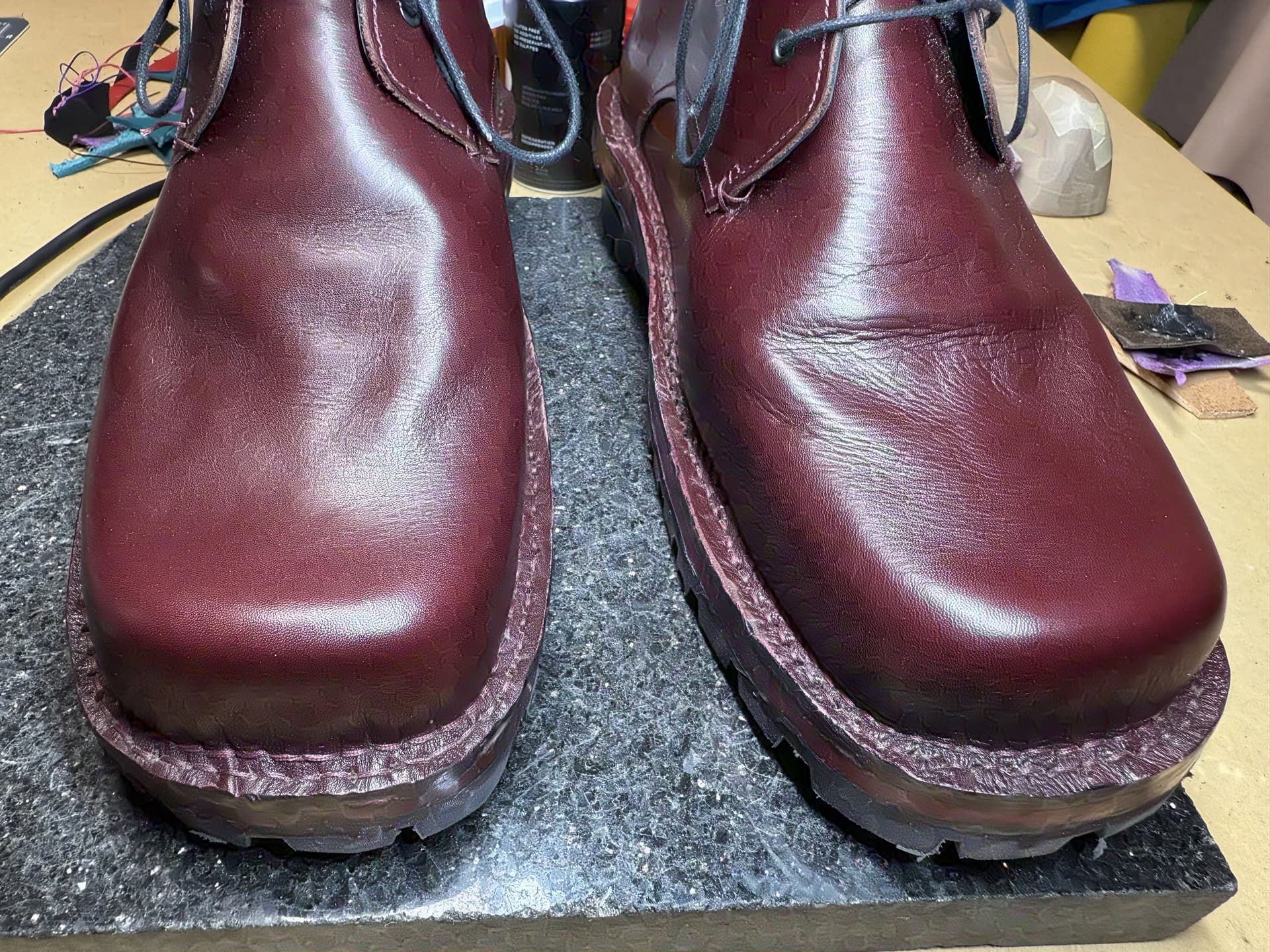
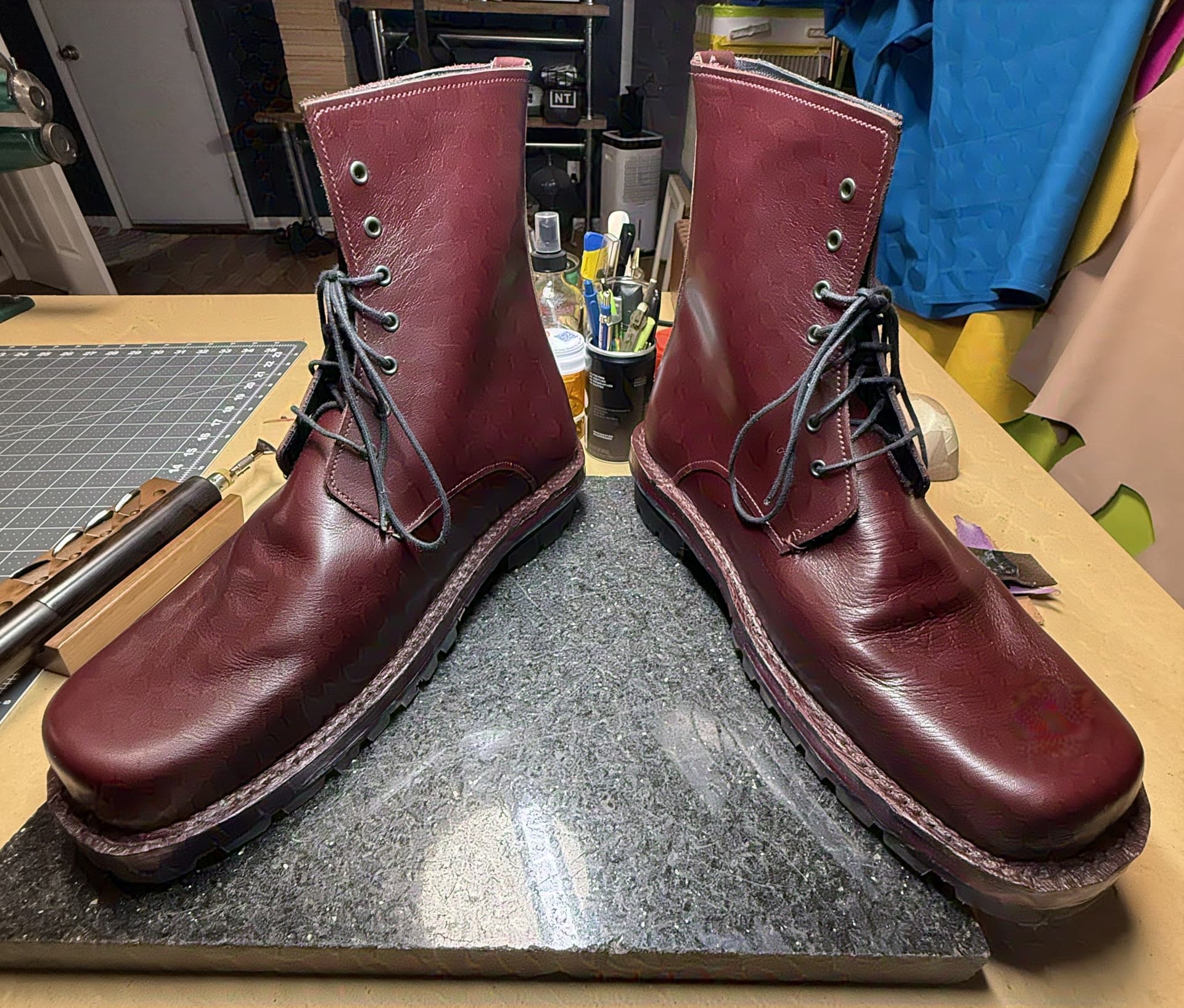
Second pair, redux

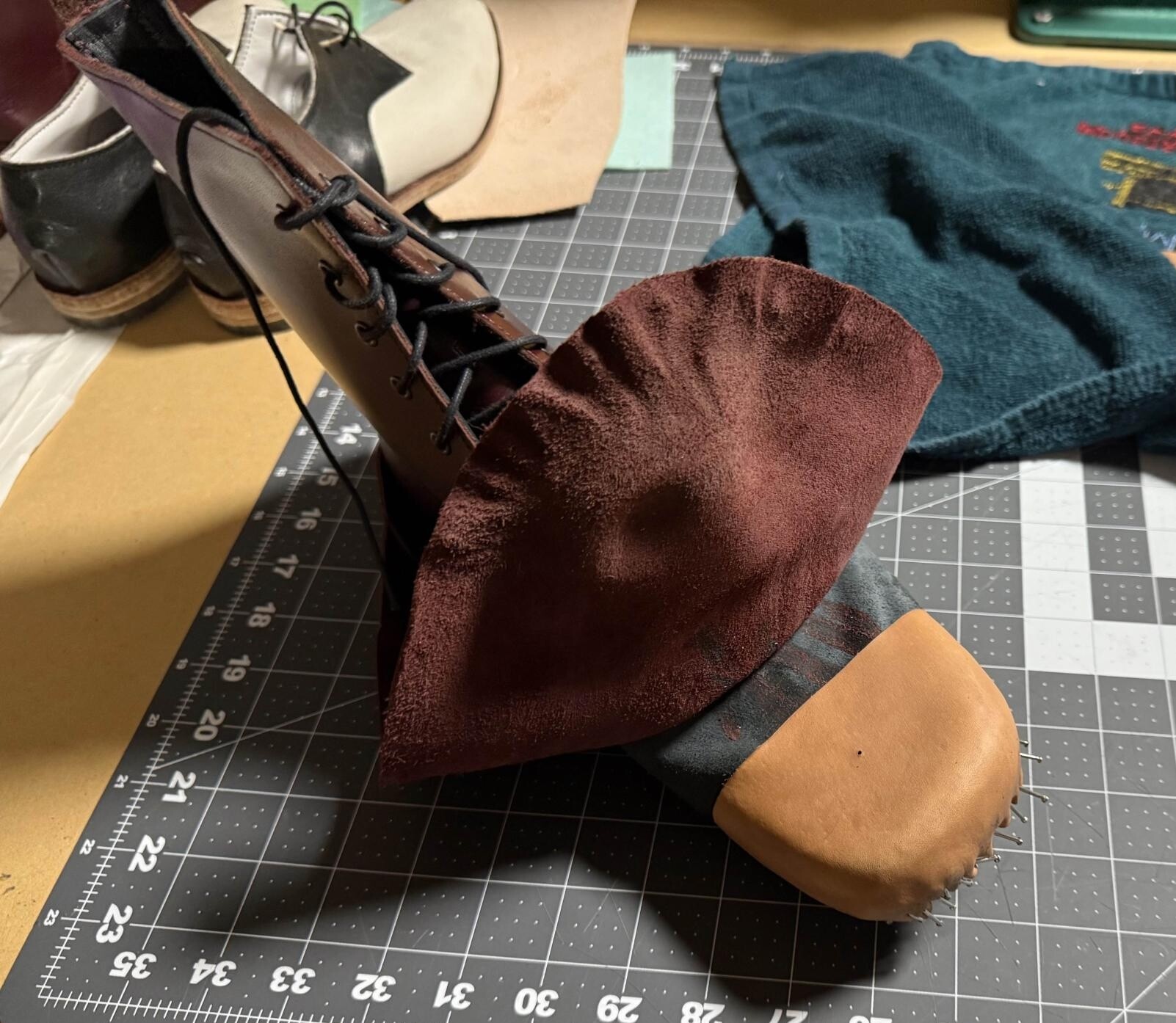
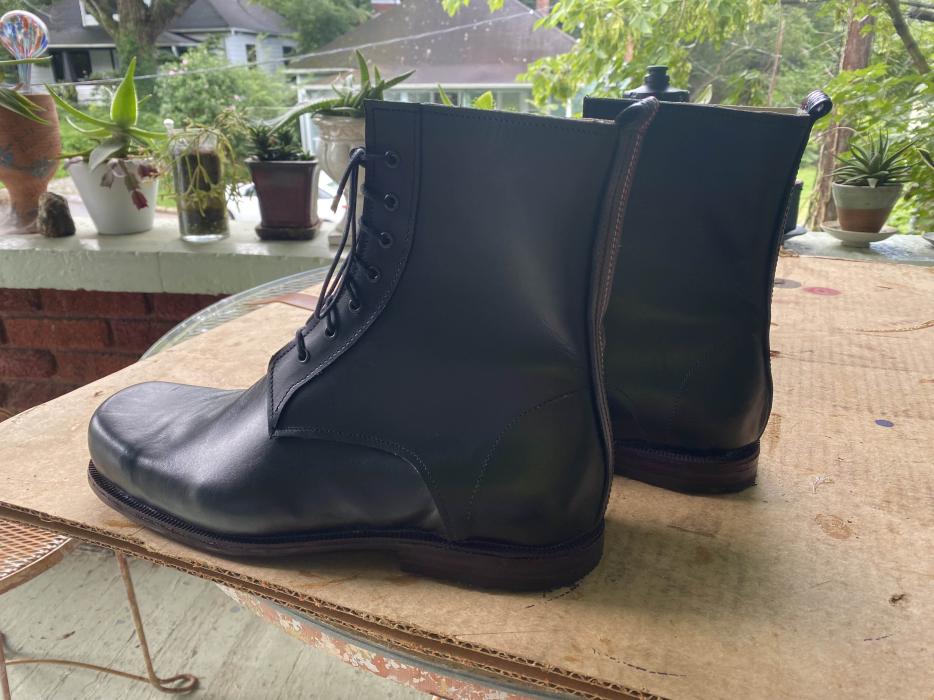
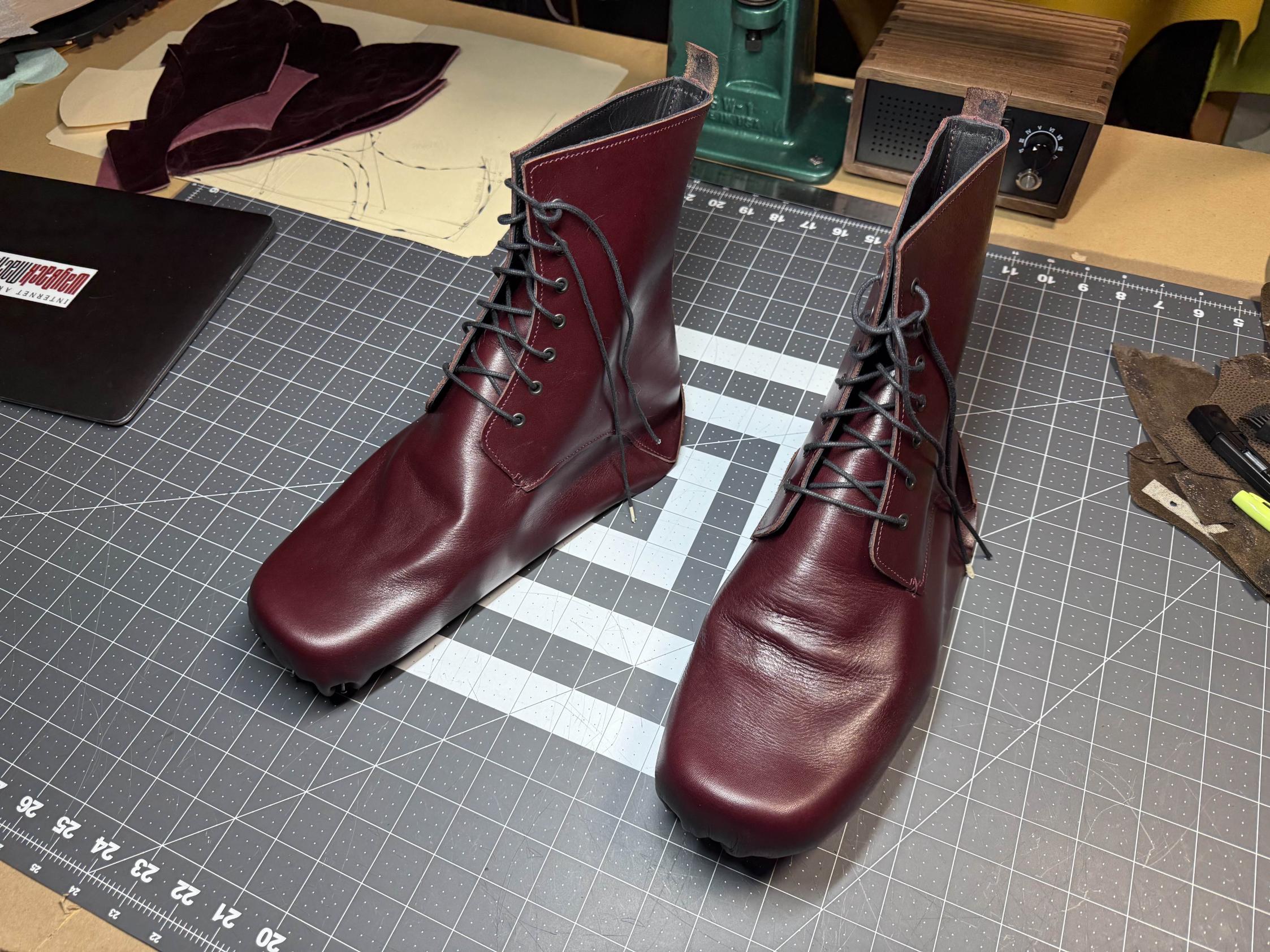
Sensing a theme yet? :zany_face: The second pair of shoes I ever made (2023) were derby boots for my partner, on a last with a super cool and really annoying flared square toe. I wanted to try doing the same boot on my own machines at home without guidance…lol I forgot some steps. This is an incredibly belated holiday gift for my partner’s brother, who has the same size feet apparently (tried on the original pair and said they fit great). So I think he’ll be understanding of some mistakes for something hand made with love.

I have some more leather from that same retired tanner I made the bat boots with, but this is oxblood. I like a clean modern look, so I left off some details from the first version, namely eyelet plackets and a decorative heel stitch. First fuck up, I forgot to put reinforcement tape where the eyelets go.

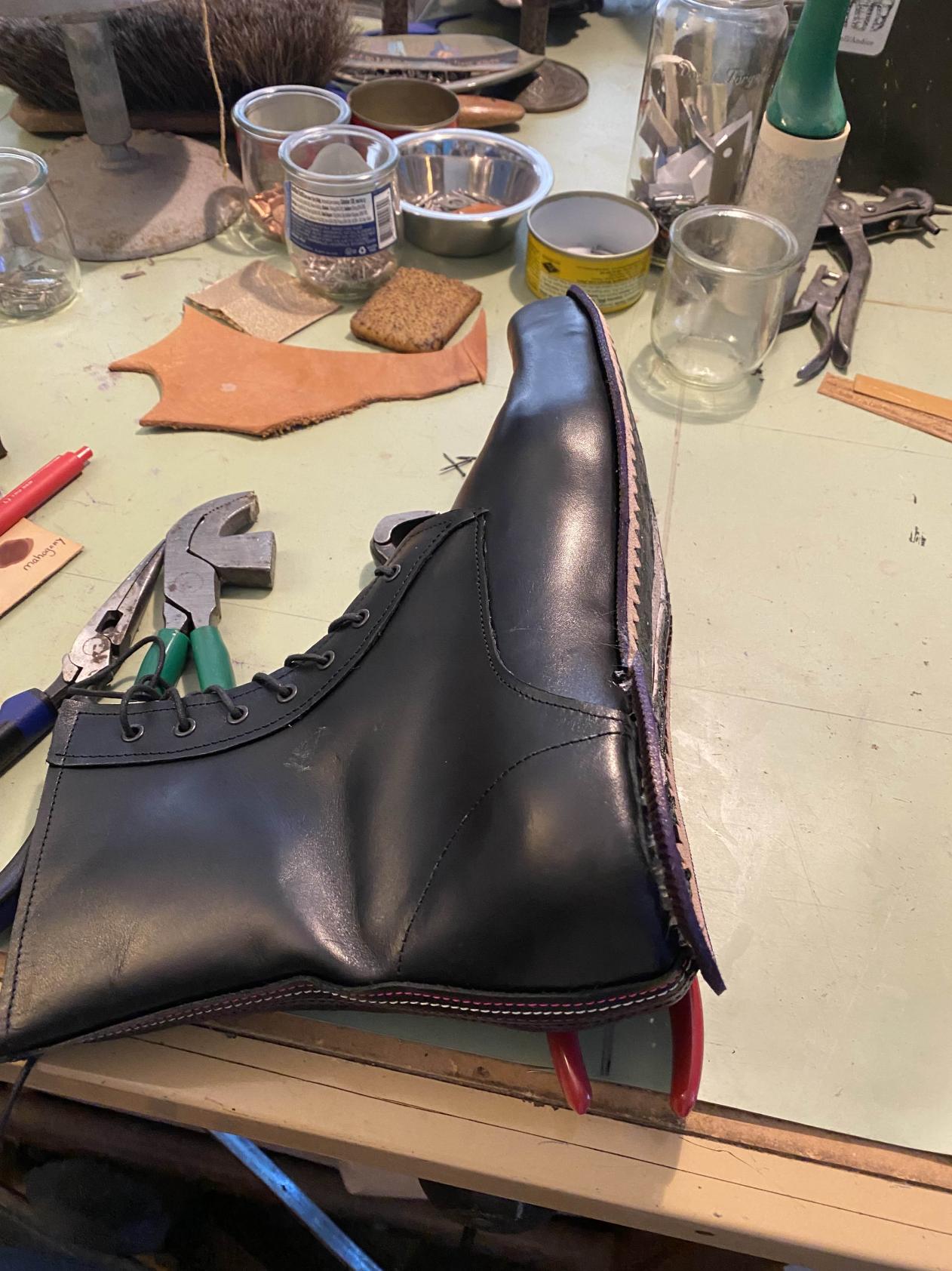
Notable on this construction is both the upper and lining have zig-zag stitching to butt them together, and putting the backstraps over that to hide them. My classmate Ray Latimer fixes up old sewing machines for fun and had fixed an old zig-zagger when I was working on the first version of these boots. He had just tried that technique on some shoes he was making and let me borrow it to try it on the boots. It was much nicer to evenly feed on a sewing machine than working through something lumpy on the side, as it might have been if it were not a butt seam. If you saw the bat boots I posted in the other thread, the reason I did that back seam and folded and stitched it down was to see what the alternative would look and stitch like. I actually thought that way was fine, but I think I would add a hair more allowance to sew down, and do it on my walking foot (or a double needle roller wheel if I could get access to one). All the stitching except closing up these boots done on my Sailrite LSZ with the smooth leather feed dogs and foot. First fuckup was forgetting the eyelet reinforcement tape.
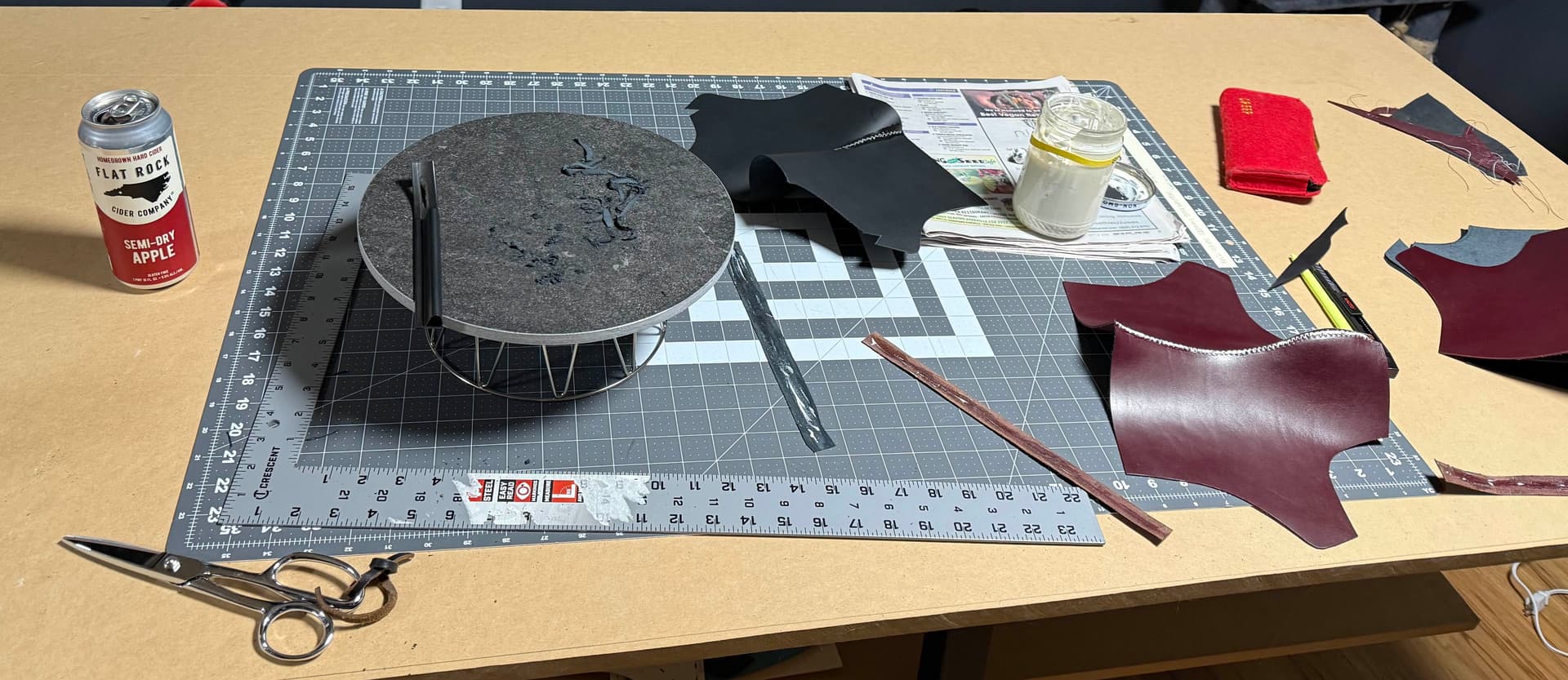
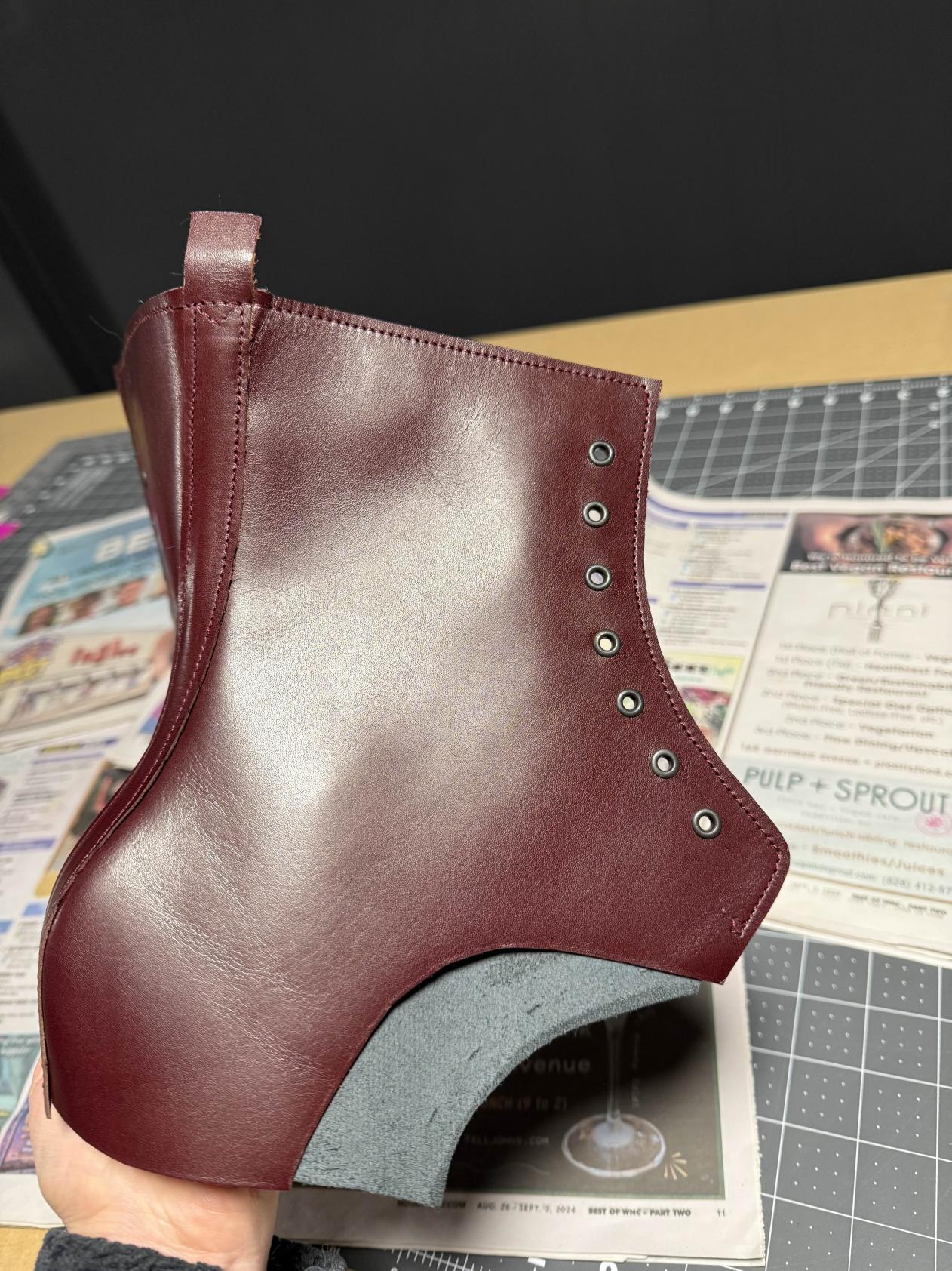

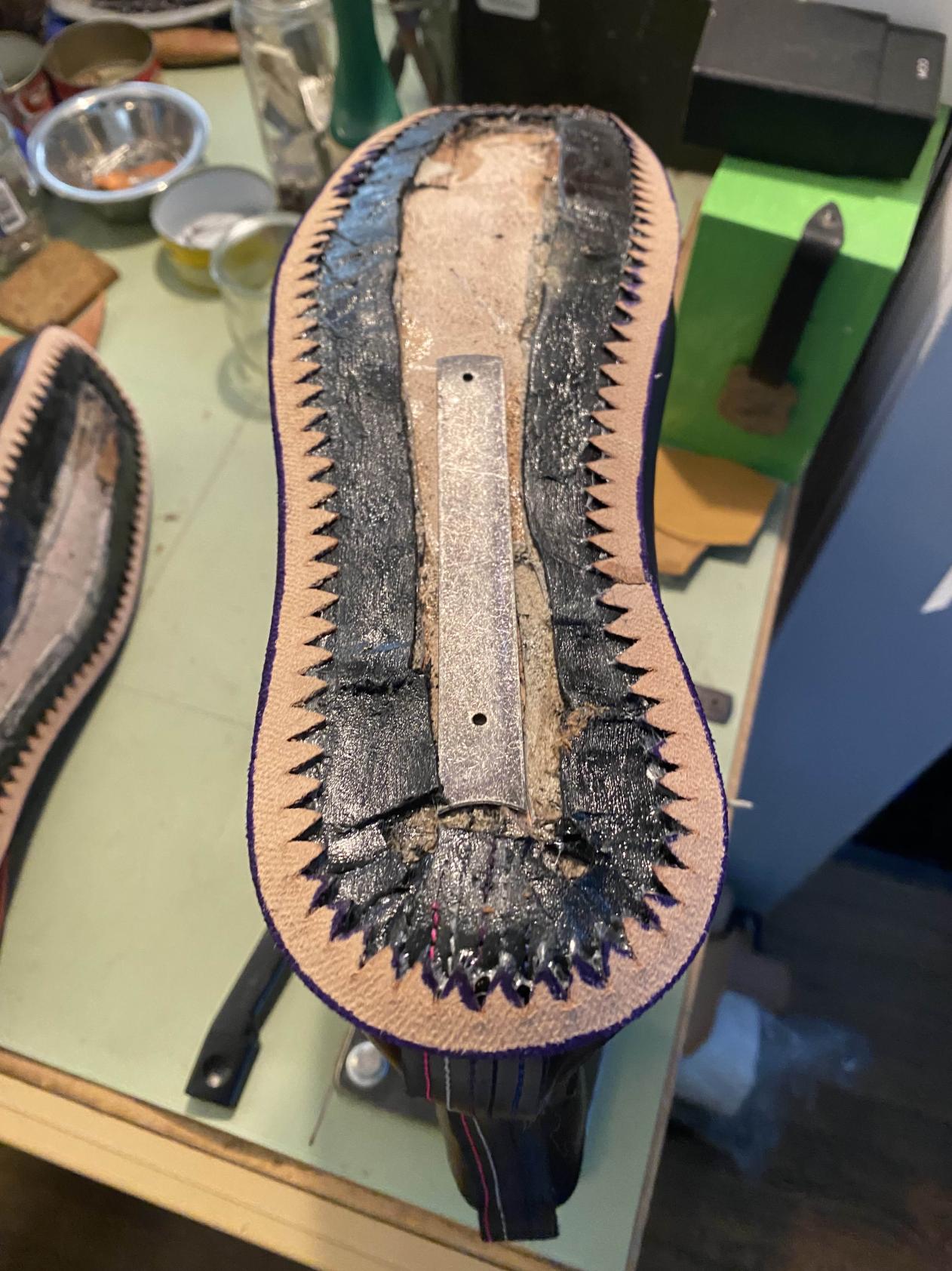
You can see how long ago I started these, I didn’t even have my space all set up here or have a decent skiving knife…At the time I also didn’t have permanent contact cement and kept accidentally ordering different brands of temporary stuff because I did not want the solvents and had not watched Lisa’s channel. When I figured out I wanted A315 it was winter and it couldn’t be shipped, so I waited quite a while to last these. In the interim I learned to stitchdown on the bat boots, and wondered if maybe I could do a stitchdown on these instead (the lasting allowance seems sufficient, so I am gonna try). In my haste to get to that step, I cemented the lining before remembering you have to shove the heel counter in before you do that. :person_facepalming: Fuck up number two.

Because this has the back straps both in the lining and on the upper, and this leather is very stiff, I’m just gonna hope that serves enough of a structural function, even though it does not wrap around the heel. I did get the toe boxes in at least. @kemitchell I saw you using wicked thick veg tan! I used 4oz. I will say previously I fucking hated the heel counter because all my lasts have heel plates. Like I’m trying to secure and wet mold this thing but I can’t use nails?? Awful. Thankfully toe boxes not like that, but this was such an aggressively curvy toe box that I did one round of wet molding and forming and then trimming it before wetting and gluing it in.
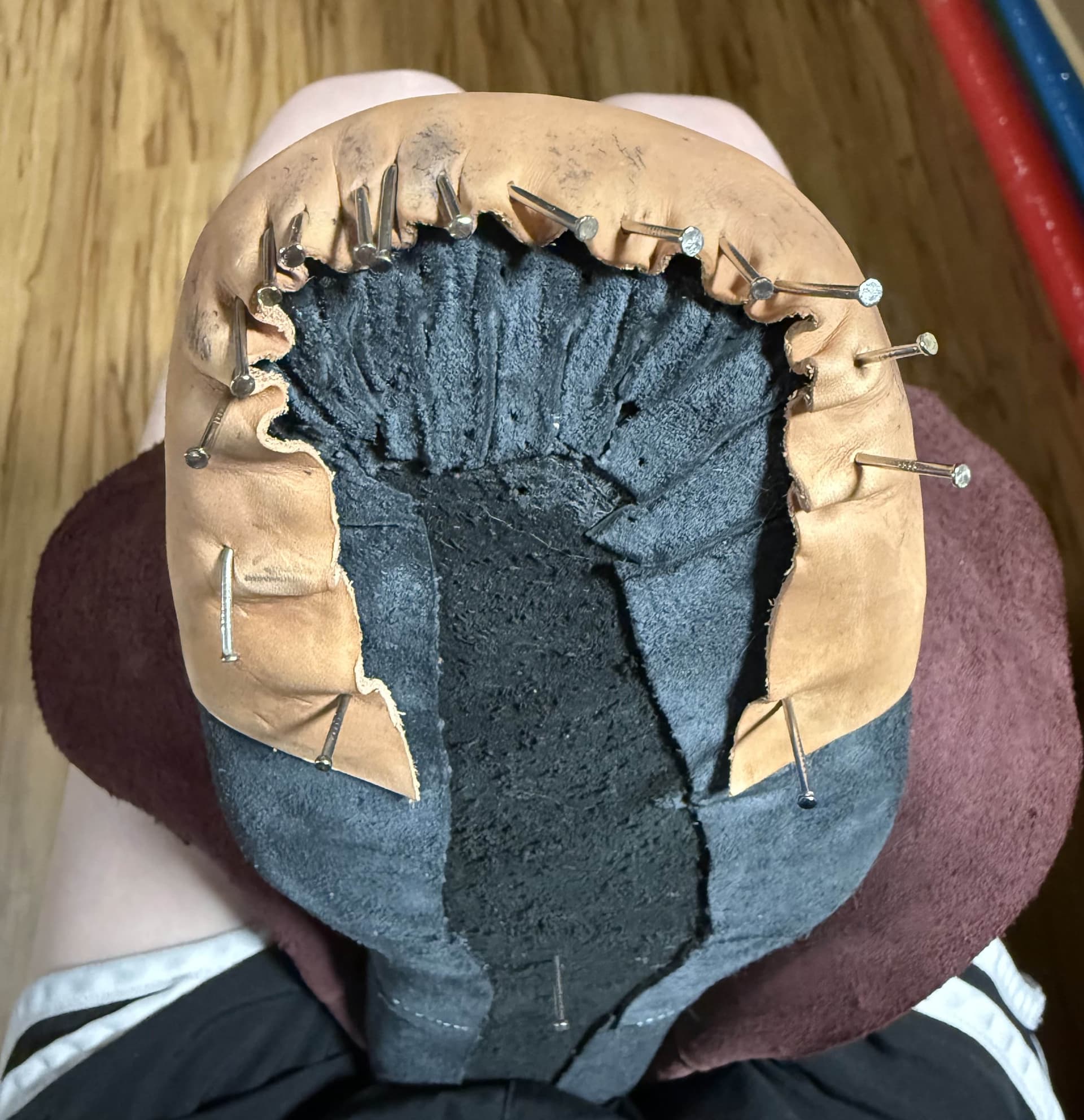
I see other folks using cork for midsoling, but I was taught with scrap chrome tan and that’s been fine, so that’s what I’ll be using here. Hoping to glue that and the shanks in today so I can do the stitchdown tomorrow. Outsole with be a layer of the same soling bend with a Dr. Soles Tumaz full sole + heel. I compared with the Vibram Montagna and I think I like this one better, but I already have another pair already mostly sewn up for these lasts after these come off :sweat_smile: so I’ll use the Vibrams on those.
1 Like

I only tried sole leather heel counters on my last pair, which unfortunately turned into a total loss. Skiving all that up was pretty hard work. I can see why the cowboy boot people inevitably use a 5-in-1 to do the skiving, or buy premades.

My other pairs have all had economy tooling leather counters. Those work fine for a lot of people. One mistake I made was not using enough paste to get a complete lamination of the lining, counter, and upper. The thinner material gives a lot more stiffness when fully adhered to surrounding layers.

Are you driving your lasting tacks all the way through your insoles? I haven’t found that necessary, so lasting over lasts with heel plates hasn’t been an issue. Even just using cheap wire nails for tacks.

Granted, I’ve also been using relatively thick leather insoles, thick enough for carving holdfasts. If you’re using thinner, less dense insoles, you may not have material for the points of the tacks to grab onto.

The Spokane boot companies almost universally use fully plated lasts, with metal from heel to toe. Their work pattern boots have chunky external heel counters, no problem. They drive their tacks for lasting heel seats and shanks all the way through, clinch them over, and leave them in. Nothing wrong with that!

I’ll give those a look, thanks! I am very interested in making a practical work boot as well. I guess what I learned from Deborah was technically dress shoes.
I suppose I have not shared pictures of my third shoe, which I have abandoned for over a year because the choice of insole leather was way too hard apparently and trying to inseam it has just been a nightmare. Per your advice (echoing Lisa IIRC) I got some Baker insole bends to try again, and this time I have actually good and sharp knives so hopefully combined with correct leather I will get somewhere this time! And perhaps the heel counters will be less of a problem. To be honest with you I had been wanting to try the thermoplastic thing anyway and was toying with the idea that maybe that’s the least annoying heel counter option and if it’s one of extremely few non-leather parts of the shoe, that’s probably still a reasonable construction choice.

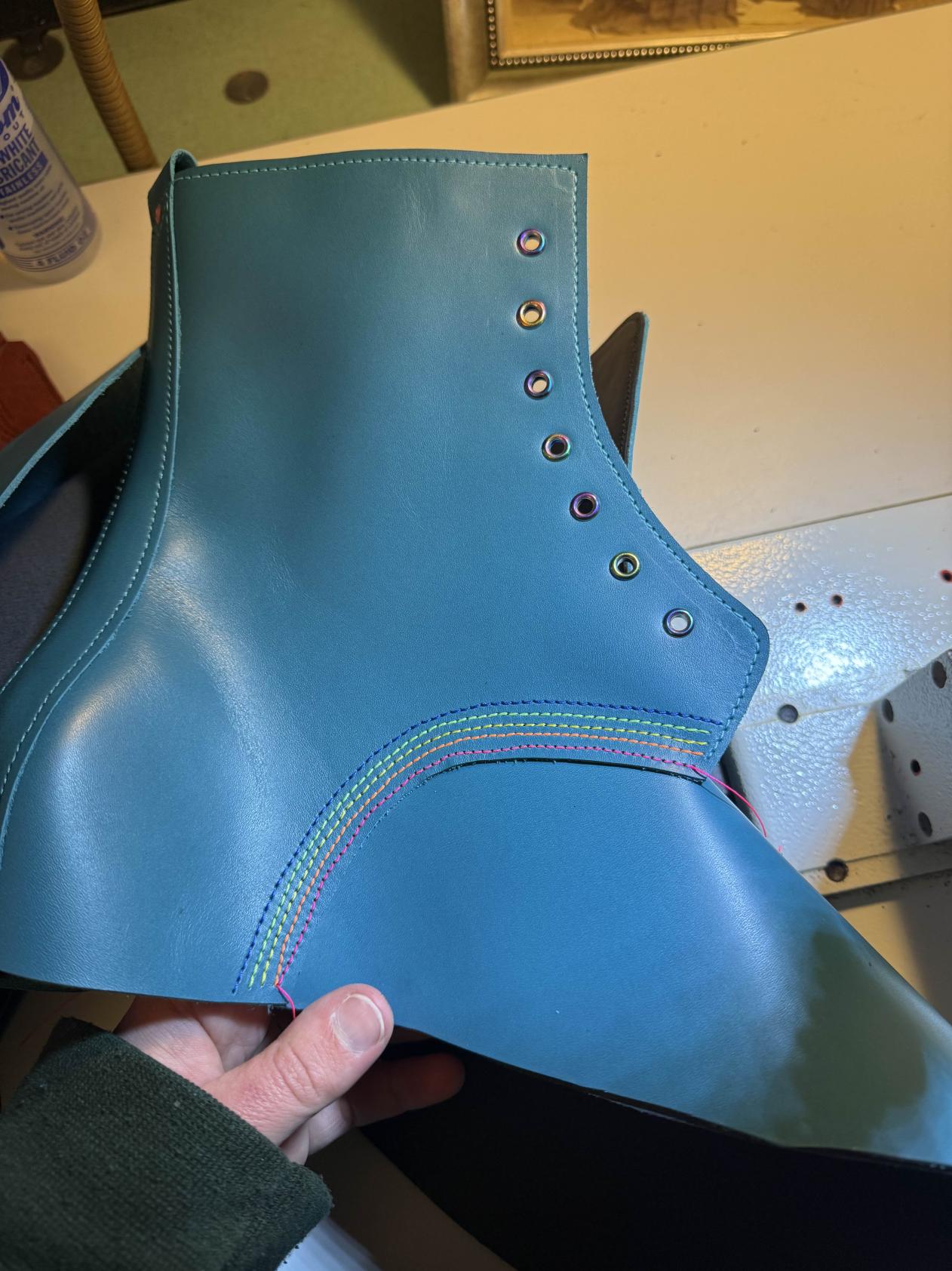
Also here’s the other pair I’m doing on the same lasts, blue leather from the same guy, rainbow stitching, oil slick purplish eyelets

Lisa doesn’t lie when she says the Baker insole stock is like nothing else. Downright luxurious—price-wise, too, of course.

I started trying to carve holdfasts in cheap, rolled, import sole bend. That went so badly that I put down for the Baker. I haven’t used Baker for every pair since, and I don’t think I really need to. But it really helped me out to plot the worst and the best, early on.

I’m still thinking there must be something Hermann Oak tans that should work. But I haven’t got there yet.

People think and feel their own ways on this. You can find old fights about it on The Crispin Colloquy, which I really hope we don’t end up reenacting here, years later.

If I were going to use something other than leather, I think I’d try the ones you soften with a heat gun, too. Why bring more organic solvents into my life?

And there are clearly advantages. If you want to sculpt a perfect toe shape down to imperceptible feather-edge transitions, I guess it’s leather or bust. But the modern factory puffs can be super thin and surprisingly strong. I don’t think factories using those products was just a step back in quality—all cons, the only pro in price. But then again I’m an enthusiastic connoisseur of synthetic plastic threads, so I’m probably not the hardest to convince.

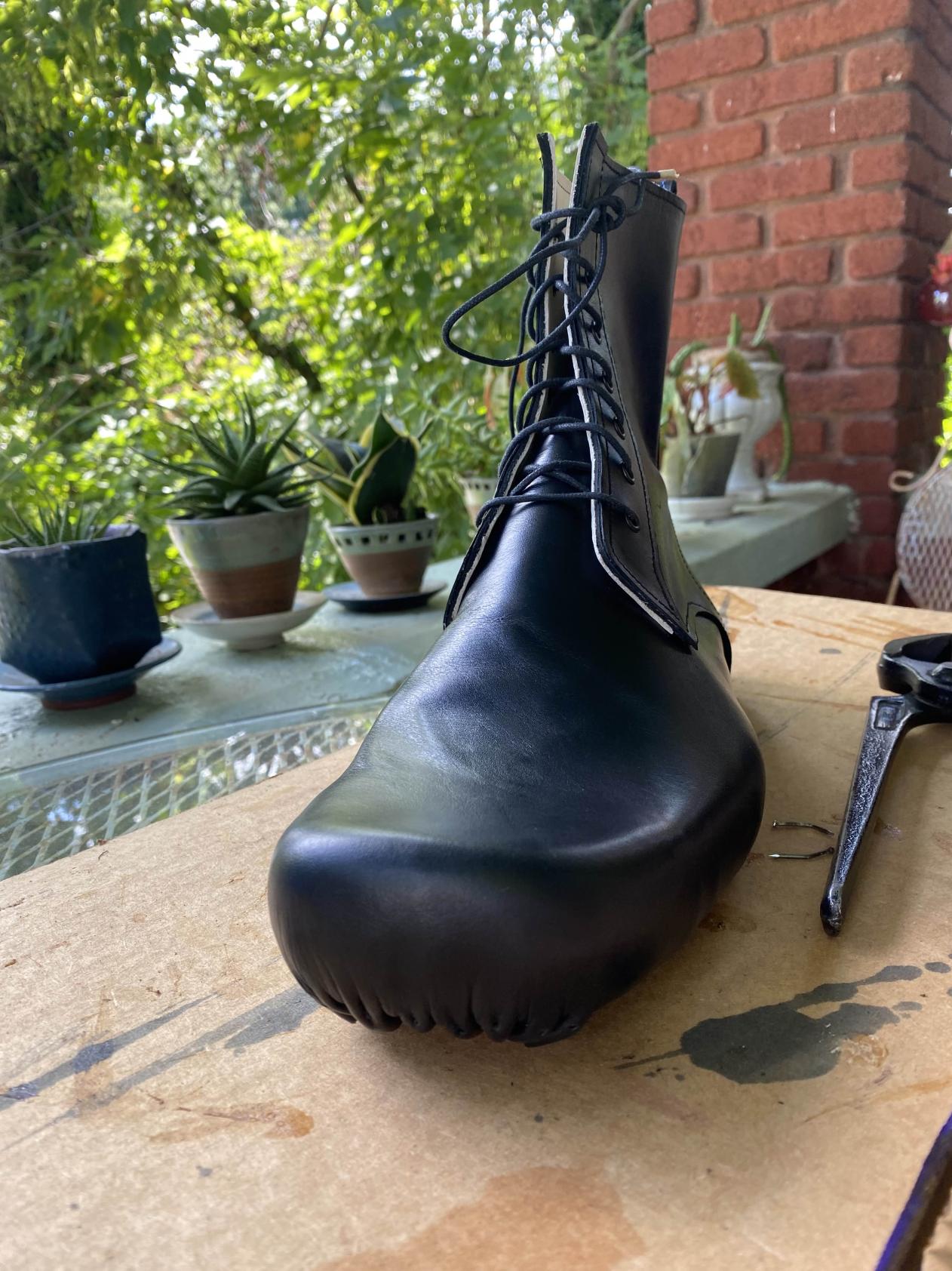
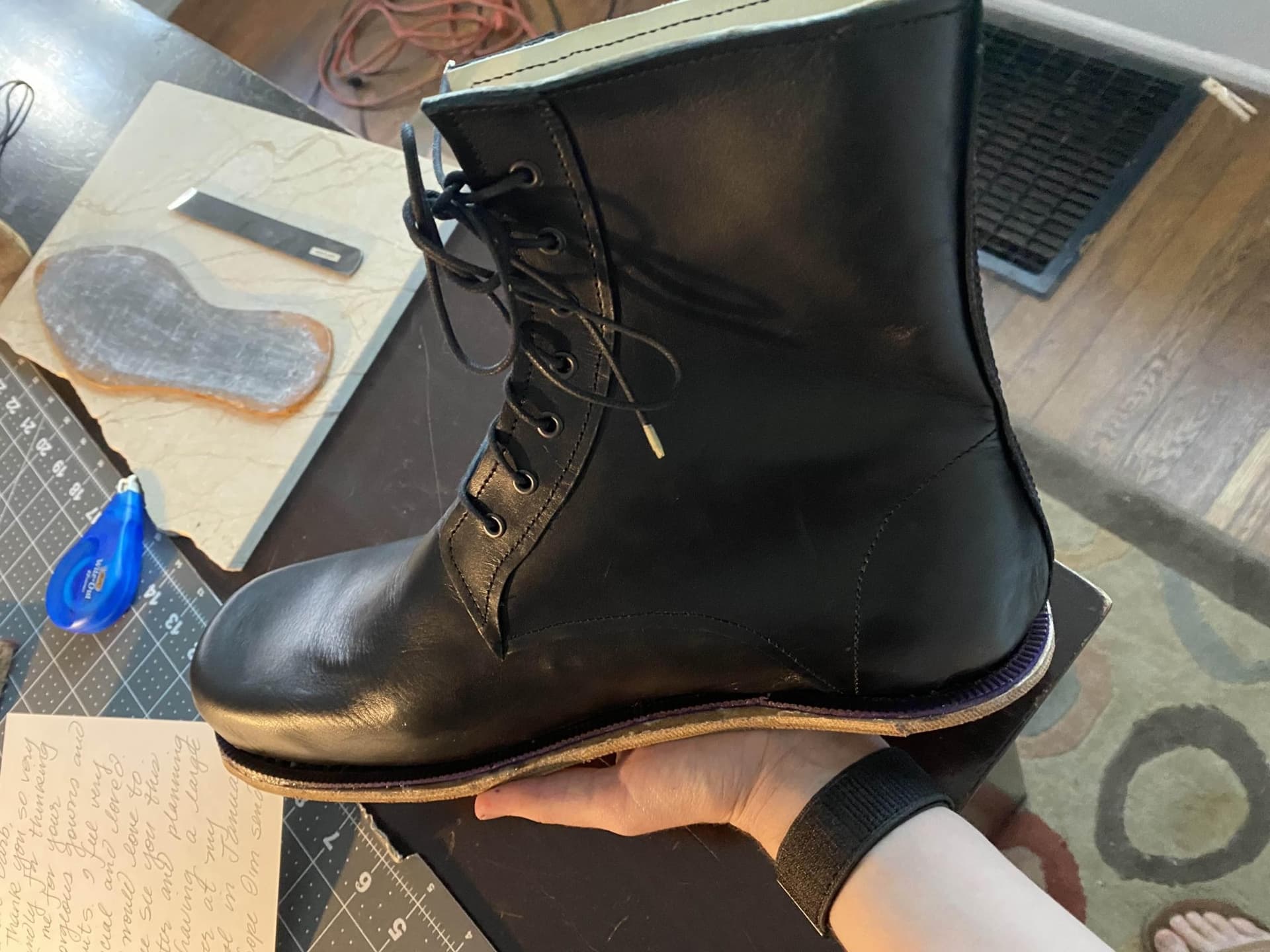
Found some photos of the first go round of these boots…now I’m wondering what loafers/slippers would be like on this last.

1 Like

The peaks of the facings sure are dandy!

I haven’t done a cemented shoe yet, but I’m planning to do test shoes that way. Thanks for sharing!

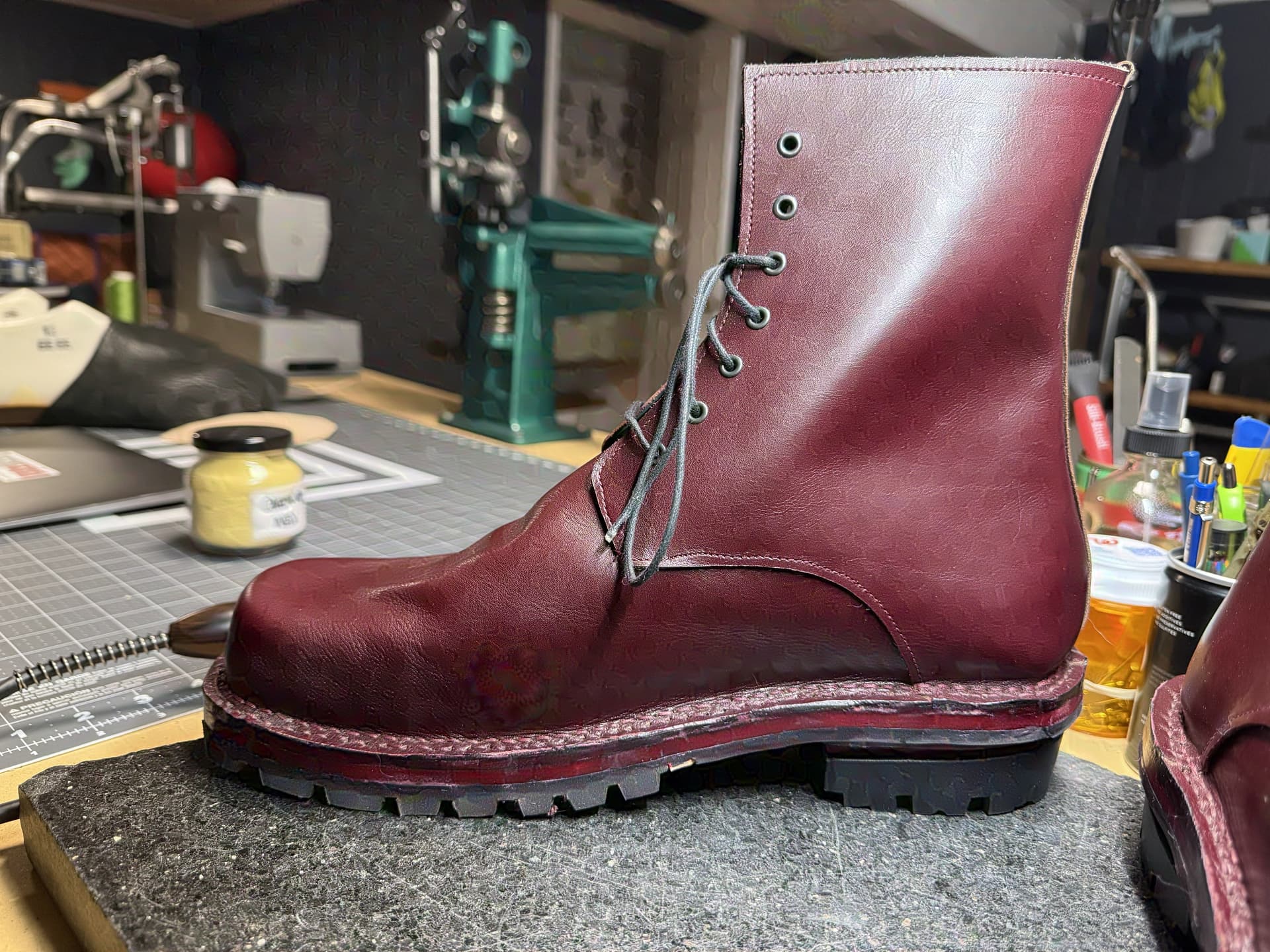
I finished these a couple weeks ago but forgot to post photos -

The A315 was not good for rubber-to-leather for me, and I did not have a sole presser, so i wound up stitching down a second row through the outsole. Reader, I do not recommend this. I broke so many awls, cut up my hands, had to use a vice grip when the awl came out of the haft, nearly nicked the upper…I wish I had a 12K or something for this.

Also, I wasn’t really prepared for how the lug heel was smaller than the whole sheet, so i panicked and did the edges on the heel rands first before attaching them and the rubber heel. Very ambivalent about how this all came out and kinda wish I maybe sanded the fronts of the rands? Idk I can’t get a sense for how the heel was “supposed” to look and picked a stack of 2 matching the size of the rubber heel based on vibes. Red dye + carnuba wax finishing on the edges. I feel like I gotta figure out how to not have the top edge fold up when I melt the wax on and polish…should I use an edger to take that off or something?

Sorry for the strange overlay, I should probably ramp the settings down on Nightshade but I had forgotten this is a public forum and not been doing my moral duty. I’ll do a non-poisoned upload of the edges for full fidelity.

1 Like


1 Like

Real glad you shared these final pics!

I would definitely take a second look at your approach to outseaming awls. I really struggled with some early pairs in ways it turned out were probably totally avoidable if I’d really dialed in a good, sharp awl blade earlier on.

I can really empathize with frustrations on bottoming. If I’m honest with myself—speaking just about my pairs now, not @citizen’s—I think I have to admit that I often get some mix of tired tired and impatient when getting to the bottoming step of a pair. In the past, I’ve been a lot less patient, and a lot less willing to pause, back up, plan, and be meticulous, once the welts are on and the cavities are filled.

Part of my answer to that has been to pick up more friends’ pairs, and used pairs for myself, just to rebottom. Good way to get practice without working through the whole lastmaking, uppermaking, and inseaming process first. But I’m also coming around to the idea that my pairs for friends will likely be ones I finish up to the bottoming stage and then take to one of the pro cobblers in my area. Some people really are best served by rubber or PU soles, and I’m not one of the hobbyists who wants to own a line finisher and a naumkeag. Even for leather soles on dress shoes or western boots, I’m learning that part’s not my favorite part of the process, at least not so far.

I’m no pro, but two things came to mind:

  1. When I was first learning to burnish edges in small goods leathercraft, I really rubbed the edges too hard. It turns out good slicking has more to do with rubbing back and forth a lot. Really pressing the stick into the leather made that seem to go faster, but also turned up big lips, like you described.

    @Mllcb42 has been sharing pics of some great results here on the forum. Perhaps we can beg some advice.

  2. Most makers I’ve seen do in fact run an edge beveler around the top edge of rands, outsoles, and welts. In the dress shoe trade, there are also specialized “rand files” and edge irons for creating smooth or stair-step rims.

When sanding/finishing, a bit of mushrooming and raising an edge is pretty much inevitable. I usually plan for it when doing small goods/uppers, etc, and use it to help index an edge creaser. Once I have ran a heated edge creaser and really set the edge, I will come in with an edge bevler to take off the corner.

In this case, the edge creaser I would use on an upper wouldn’t apply, but I have seen some tools that serve a similar purpose to setting the edge. Personally, I would still run an edge bevler.

Yup. I tend to do all my burnishing now just using a piece of canvas. Don’t even reach for the burnishing stick. Light touch, lots of speed. You’re going for heat due to friction rather than pressure.

1 Like

I’m gonna do burnishing on the edges of a future pair of soles…I made a test pair (where I made a bunch of weird choices just to see what would happen) where I stacked different
colorful 8-9 oz veg tan and did the carnuba wax thing. It made the teal and dark blue nearly indistinguishable, vs the other pieces I burnished the edges of. I guess I haven’t compared that with sanding and doing the clear edge sealant.

1 Like

Wait, maybe I am an idiot - my teacher has a 3 legged cobbler’s anvil. Is there any reason I couldn’t use that to finish the rest of the sole with nails?

1 Like

I’m not totally sure I understand your question, but it’s perfectly possible to bottom shoes on cobblers’ anvils. Lots of makers prefer to bottom on the lasts, since they’re already in and only help shape the uppers when left in longer. But you can inseam and then do everything else on an anvil. It’s what cobblers do on full resoles.