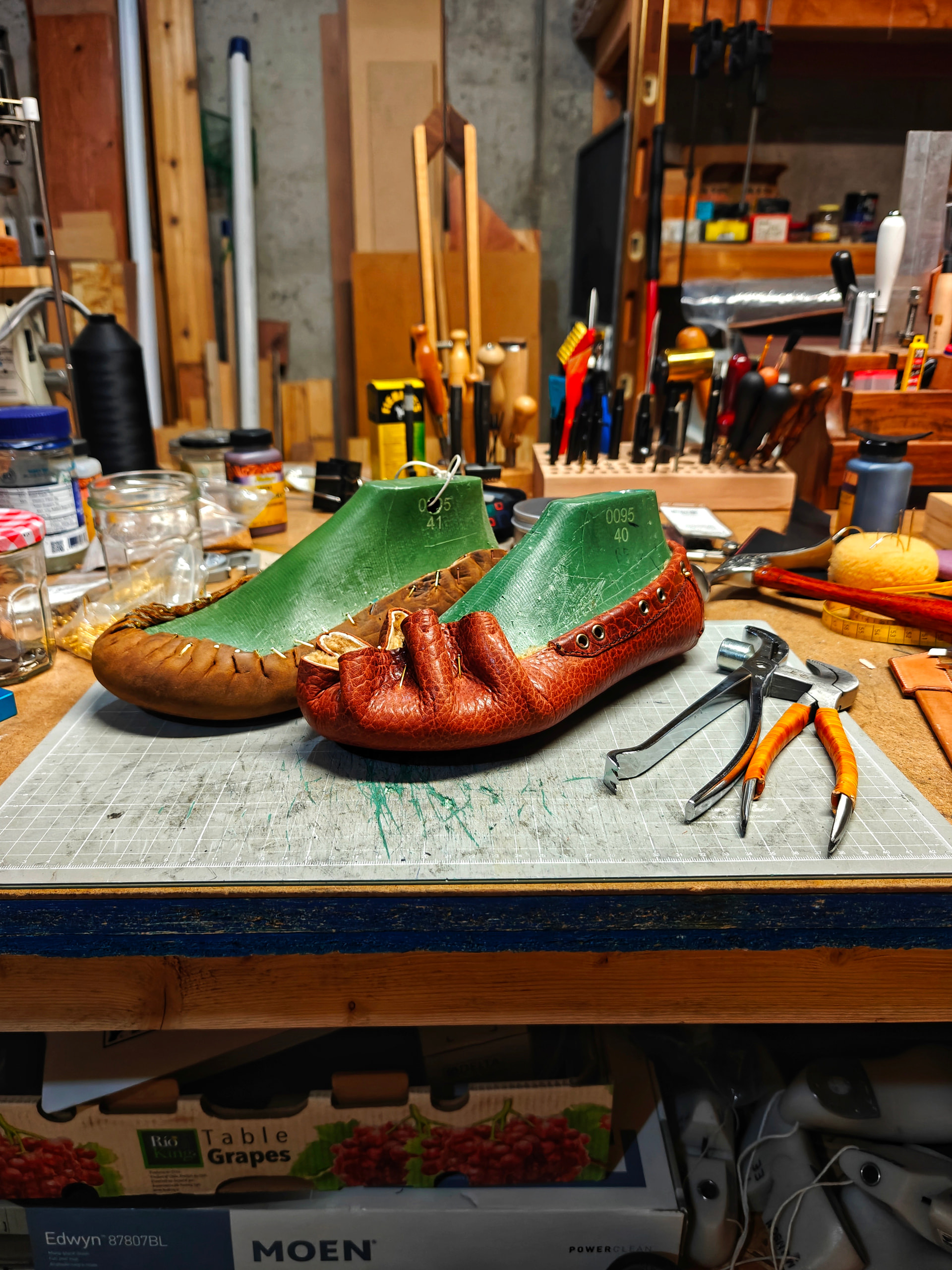
So I am trying to find out adhesive options for doing molded soles on my moccasin footwear. It’s exactly how Russell Moccasin does it. I have two different size lasts, with the larger one being the last used for the molded sole. Once everything is ready, I rough up the respective areas and mate the molded sole to the main body.
My curiosity is about what kind of slower setting glue I could use. Standard contact cements, either solvent or water based, leave little room for error. The process of mating the two parts is not one that’s super easily done on the first try. There needs to be some wiggle room for getting things into the right places.
I can not tell which adhesive RM uses based on their videos, but it does seem like some sort of slower setting situation. I used Hirschkleber on the two boots I have done molded soles on. While it does work, I don’t think it’s optimal. It adds some stiffness, and the flexing of the boot might lower the quality of the bond. I obviously have stitch lines for a mechanical fastening, but I would still prefer to have as many bonding options as possible.
Thanks
Several makers use PVA for longer work time, when things need to slide before bonding. If you watch too many Nicks videos, you’ll see TS-Boy-style pots labeled “Yellow Glue” all over the lasters’ benches.
The old-school long-work adhesive in the English shoe manuals was starch paste. You’ll also see warnings about mold growth and ship rats eating shoes in transit.
Hirschkleber and Zlatomaz are newfangled versions of the old starch paste, based on starches modified to be shelf-stable. They will slightly harden leathers, but if you slather it on some test pieces of loose leather without laying them into uppers like stiffeners, you’ll see the effect’s not that great. Most of the stiffness of stiffeners comes from laminating them to lining and upper layers, a bit like gluing veneers into plywood does.
That’s all I’ve got. Have you tried just e-mailing Russell? There can’t be that many other folks making that kind of moc in the States. You might just get an answer.
I actually did send them an email. They’re hit or miss as far as wanting to give out info. We’ll see if they’re willing to share adhesive secrets. Haha
Maybe PVA is the trick then? I know I might be able to do a slightly wet Barge application, but I am not a massive fan of that. There’s also the option to Barge as normal, then put some wax paper in between layers to help get things into place, then pull it out. But that could still be pretty odd.
Here are the slippers I am working on. Basically just a shearling Oneida on a barefoot last.
Any responses from manufacturers on their processes are pure generosity. Sometimes it’s not even that they don’t want to share, but just that mentoring makers isn’t how they make a living, and they probably have a backlog of customer queries, besides.
Have Russell published any making-of videos showing the step where they put on the glue you’re worried about? You might link it to give folks a chance to put second eyes on it.
Some of the neoprene-based cements do seem to get reused like glues. Renia recommends letting 315 cure like solvent-based contact cement, but for small jobs just brushing on and sticking together does give a bond, especially between drier leathers, like for many small goods. I suppose you could dilute a neoprene-based cement to the point where it doesn’t immediately bond, but you’d have to worry about where all that solvent or water will go.
This is a molded sole video, and it looks like he just paints some sort of glue on and sticks it right in there.
Another where he just seemingly paints it on real quick. This one basically just gives an idea of the color.
Not a molded sole, but they are laminating the inner vamp into the main vamp. The glue looks to be the same, and it doesn’t immediately bond in a prohibitive manner like Barge tends to want to do, at least when it gets tacky.
1 Like
Can’t be sure, but that does not look like PVA to me, either white or yellow. It seems to be a pretty translucent amber color going on.
I’ve been exploring the same thing recently so I can glue a drop in liner in place and be able to smooth it on the last. I’ve messed with PVA wood glue (titebond i), PVA bookbinding glue, hirshckleber (i used to use zlatomaz but after it went super moldy and New River Dave said he had two jars do the same, I switched), ecostick 5020 slow-setting (not sure maybe neoprene, from tannery row), aquilim GL slow setting neoprene, One of the nice things about water based cements is you can control their tack and setting speed a little with things like spritzing the surface with water first, or mixing in a humectant like glycerin or methyl cellulose. Book binders swear by PVA for strength mixed with methyl cellulose powder for high strength and low tack for repositioning front papers , without the inflexibility of straight starch. And methyl cellulose is inedible to bacteria unlike vegetable starch. I haven’t tried that one yet. I was happy with both SG and 5020 for moderately strong adhesion to assemble things that wilL be stitched or otherwise permanently attached later, or won’t have a lot of force like binding a liner to upper, but i could pull them apart even a couple days later if i tried. A little glycerin in titebond well I didn’t measure anything but it didn’t bond well. I thought all the pva’s were too tacky for sliding layers unmodified. But some of the other shoe guys swear by Elmer’s and I haven’t tried that yet either. So far my favorite is GL or 5020 with pre-misted surfaces
1 Like
That’s a bummer. I was feeling better about having two sources for premade paste.
I think this is a good direction to go. I just watched Renia’s video on it, and it seems like what I am looking for. Sounds like it’s a slower bonding version of 315 basically, and when done properly, can have similar end strength. But it does allow repositioning and moving things around a bit, which is definitely something I need. I’ll probably order a small bottle from Rocky Mountain and see how it works out.
2 Likes
Let us know!
Here are the bullet points from my notes of one of the Renia videos:
-
weaker at first
-
very similar to 315
-
slower to develop full strength
-
can split apart for half to a full hour
-
final bond about as strong
-
don’t use as the only bond
-
e.g. in upper construction to hold for sewing
-
doesn’t clog needles
-
can use as contact adhesive, but slower
In my humble it didn’t end up as strong as 315 in similar applications but there are a lot of variables and you should experiment
1 Like
@x24leathers you might try asking Renia what they’d recommend. Or their US division. You might even send them a screenshot or a link to one of the Russell videos and ask them to guess.
I’ve never e-mailed Renia before, but the Baltors—my local shoe suppliers—say good things.
Nori paste works too. I have no clue if it molds but it’s cheaper than Hirshkleber.
Hadn’t heard of Nori Paste. The Yasutomo-brand product by that name is reportedly cornstarch:
What are the main ingredients in your Nori Paste? The main components are water and cornstarch.
https://yasutomo.com/product/np56j-nori-paste-10-oz/
An MSDS I found mentions sodium benzoate and aluminum sulfate, which I know as a preservative and a coagulant, respectively. 75-80% water.
I met that renia guy from the videos at a trade show. He didn’t seem to know much beyond the marketing stuff but was open to talk. He was … German  A bit brusque for a salesman but harmless
1 Like
That’s fair, but it also won’t be the only method of attachment. I’ll also have stitching on the sidewall areas to keep the molded soles on. I’m hoping that, with the constant downward pressure of walking, will keep them in place the way I want.
Also a good idea, thank you. I haven’t heard back from Russell, but I will give Renia a shot.
Hahaha. Sounds very German.
1 Like
So here’s an interesting video I stumbled across when looking for Aquilim GL videos. He just uses Aquilim 315 single sided for a pretty damned strong bond. I wouldn’t consider it for any bond that was adhesive only. But it does seem pretty plausible for my use case. Paint the interior of my molded soles, jam them on the main shoe body, tack and hammer in place to set the glue. When he goes to pull them apart, it looks like he even gets a touch of fiber destruction, not just glue failure.
1 Like
Oh cool. I bet if you hammer it while still wet it penetrates each side deeper before polymerizing than if you just leave it to dry on the surface. I’ve noticed thinner glues bond tighter i think for similar reasons. Like i imagine little rootlets of glue reaching down deeper and grabbing more fibers on each side. Once the glue is stronger than the fibers the strength of the glue doesn’t matter any more just the distribution
It also says if you are bonding dense to porous (eg grain to flesh) then just apply to the grain side. Also it recommends to degrease
1 Like
Here’s something interesting. (At least to me) Terry Kim just uses wood glue when doing heel counters and toe puffs. That could also be a viable option for a strong enough glue. I wonder how it affects flexibility? All adhesives do to some extent, but some are less stiff than others.
I did get in the Aquilim GL and use it on my molded soles. Sticks just fine enough for this situation. Ends up feeling kind of like rubber cement, at least when pulling dried glue off the rim of the jar. I’m working my way through handsewing the first one, only heel area though. Rest of the rim is machine sewn.
1 Like
I have used wood glue on counters and toe puffs. Works fine. Wood glue is just a pva glue.
1 Like