I’d be interested to read about what folks use to lubricate awls when inseaming and outseaming.
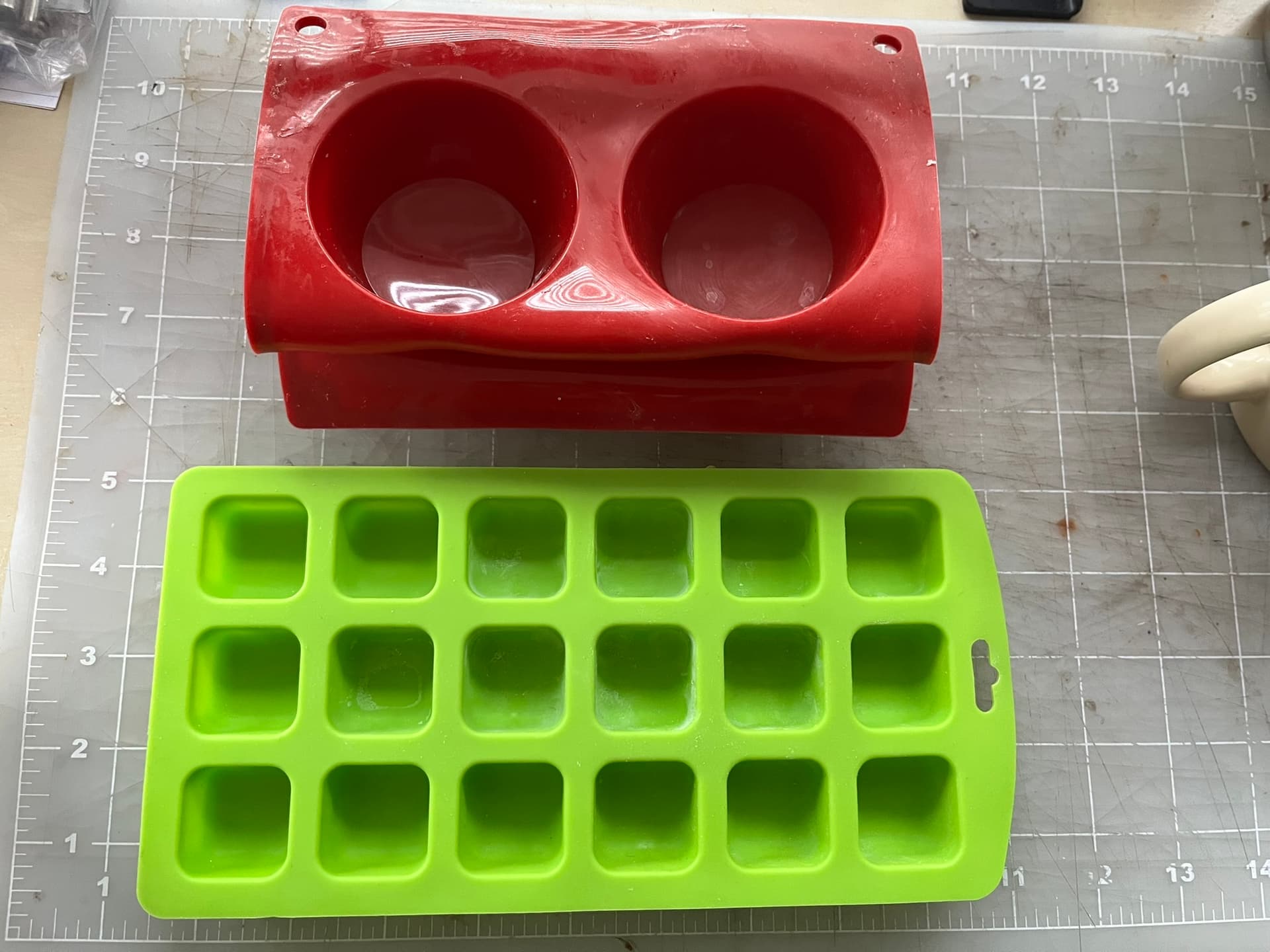
I did my first few pairs sticking my awls into pure beeswax. For a while I stored my awls stuck into a hardened pool of beeswax poured into a shallow stainless bowl. I’d try to remember to stick the point back in there before every hole. Eventually I poured out a little pat of wax, using a silicone ice cube tray, that I could leave on the insole during inseaming, so I didn’t have to reach.
The pure beeswax was pretty hard, and I found myself pushing the bowl around and knocking it over. The little pat I’d put on the insole would also get pushed around, and when I took time to really stick it, it sometimes got stuck to the end of the awl. I recently decided to cook up a 50-50-by-weight mixture of beeswax and mineral oil to try instead. I’ve long used mineral oil and beeswax mixtures to condition wooden cutting boards in the kitchen, and I’d read about other shoemakers using soap or other, less viscous lubricants for their awls.
I also thought about using a pure beeswax candle or a little hot plate under beeswax, so it’s still pure but also runny. But that seemed to put an awful lot of wax on the awl, which would harden pretty quickly and potentially flake off all over the work. I also started to worry about the temper of the awl, putting it near an open flame over and over again.
I like the ice cube idea
Before i had pure beeswax i used obenaufs basically beeswax plus some solvent to soften it up, looking back i liked it pretty well. I also tried pecards which is really just petrolatum also worked. The last two didnt hold the awls as well though of course.
For making balls of wax, I just pour it into a basin with water, a bit like coad. That creates a different consistency, but you can round and pat it into shape by hand.
I hadn’t thought about Obenauf’s or similar products! I vaguely recall there are other ingredients in those—propolis in Obenauf’s, for example—but I doubt many of them matter. For ready made, not a bad idea! And they tend to come in nice little squat containers.
I do find it easy enough to buy mineral oil from the corner pharmacy and get beeswax locally or online. There are also astoundingly cheap stainless melting bowls, like this one.
I started learning traditional shoemaking about a year and half ago, focusing on 18th century shoes, at least for now. The instructor always uses mutton tallow for lubricating awls when closing uppers in particular. I’ve gotten to used to it, I use it now for all of my leatherworking. You can locate small tins full of mutton tallow easily on Amazon. I have also use beef tallow, but mutton tallow is a bit less greasy and tends to not stain the leather.
Welcome to the forum! Please feel free to jump into conversations, and start your own new topics, anytime.
Interesting about the mutton tallow in particular. I wouldn’t have thought about differences between animal tallows like that.
I’ve read that flour paste in shoes would cause problems, due to rats wanting to eat it. Especially in the export trade, during long voyages on ship. I wonder if tallow posed a similar problem.
@lt508th I finally got around to looking for mutton tallow online, and was pleased to find small tins of supposedly 100% mutton tallow for well less than $10, from several sources. I’m seeing lots of packaging marked “sebo de carnero” and “sebo flandes” as well.
@kemitchell Excellent! The small tins of mutton tallow are usually available on Amazon for @ $6. I believe “sebo” is the Spanish word for tallow or suet. Try it out, it really is excellent stuff to work with. You can find it in much larger quantities, more typically on places such as Etsy for a significantly lower price per ounce or pound. I use either mutton tallow (suet) or rendered beef tallow to make traditional leather dressing, which both feeds the leather and provides some level of waterproofing.