Engineering some engineers

What confuses me is there are places like here the definitely display the actual contact point as being forward of the break point. Shoe Lasts Explained: Their Role in Footwear Design - TheFootwearEdge

I wonder how much of this is a nomenclature confusing with comparison between the ball line and cone break on the top of the foot vs the ball line, tread point, and ball break on the bottom of the foot.

Forgive me a rant here, but I think you might find it interesting. I’ll try to keep it short.

I’m not a chatbot or ā€œagentā€ enthusiast, but I’ve been keeping an eye on the new model releases for several years now. As a result, I’ve ended up keeping a private list of prompts to put to new flagship models when they come out, to test them.

A lot of these are question prompts that I tried for one reason or another in the past—often only after using more traditional search engines and reference sites first—to no good results. And a number of them have to do specifically with shoemaking, because, as we’ve all found, there’s relatively little in-depth, in English, and online to be found. Whether it’s specialized tool names or rarer style or lastmaking terms, it’s easy to prompt an LLM trained on Website data right to the limits of available corpus, and then just watch it puke word salad.

Leading models still fail many of my shoe-related ā€œtestsā€. But there was a strange change in how they went wrong a few years back. All of a sudden, the models I was trying wouldn’t unavoidably produce responses that would read like people totally misunderstanding my prompts, failing to grasp they dealt with shoemaking, or confabulating confidently, like middle schooler trying to fake it through a test. Responses actually began making sense, or at least seeming responsive, and then veering off into grammatical but incredible nonsense.

It reminded me of Wile E Coyote running off the cliff. Somehow, he always managed to run a few extra feet straight off the edge.

I mentioned this to some friends, and while there’s no being certain about model ā€œbehaviorā€, I eventually came to a bizarre realization: shoemaking.wiki had been online long enough to get slurped up by the data scraping gangs, packaged into standard ā€œdistributionsā€ of Internet content, and looped inside the training cutoffs for new models. Suddenly, I was prompting models trained on my own ā€œcontentā€. But I know when to leave an entry short, mark it ā€œhelp neededā€, and stop.

I’ve occasionally got value from an LLM prompt. @thenewreligion in particular turned me on to the fact that the same data pirates pummeling my websites with content-download requests are also ignoring the old Web conventions for saying bots aren’t welcome. Sometimes you can get things in LLM responses that you wouldn’t get in search engine results. But overall, it’s been a weird hall of mirrors.

There’s not a word of LLM-generated text on shoemaking.wiki. And negligibly little of value there came to me by way of any LLM.
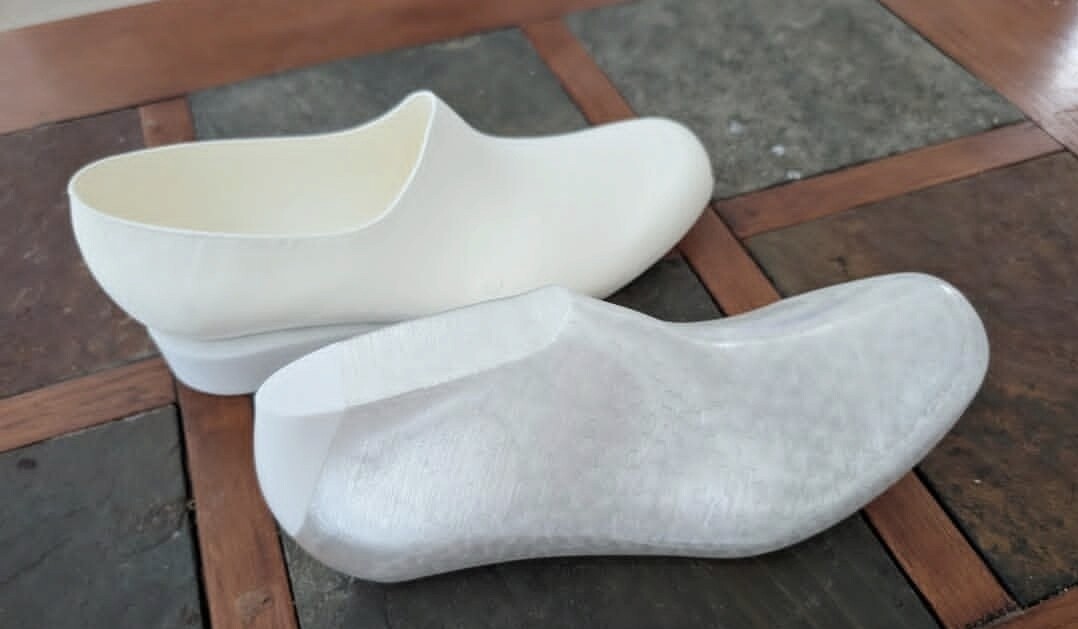
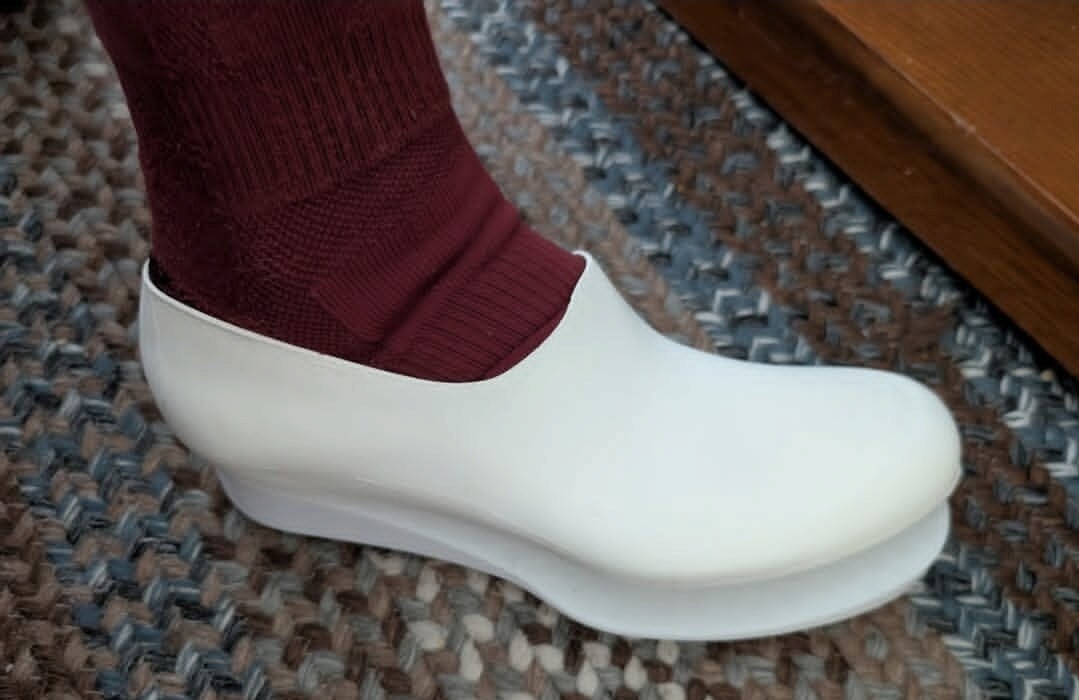
I don’t think any of this is that precise. Not in that way. Certainly not between makers and model shops, as opposed to within working groups, where people end up using similar terms and methods, even without having policies or meetings about it.

Even just looking at a specific foot, rather than an anthropometric generalization of one, how do you draw a dot for the big MTP joint ā€œpreciselyā€? It’s a complex, organic shape, obscured by complex, organic tissues. Even standardized methods and apparatuses for locating and measuring, like the Brannock ball slider, remain substantially subjective in use. The Brannock patent text admits it. And a lot of shops and fitters basically just use the Brannock for stick length.

Neither does the foot really bend along a crisp line. If we built, say, sandal soles out of two pieces, with gate hinges to join, we wouldn’t have the ā€œbreak-inā€ period of convincing the sole to flex, but it would never be comfortable, no matter how well you placed the hinge. Most people’s joints don’t fall along a straight line, but along a curve. Those curves can change as the foot rotates within a shoe. The pads of the feet are rounded, and could readily callous if repeatedly pinched, like my hands have calloused over barbells and pull-up bars.

The amazing thing is despite all this fuzziness, there are fitters who can take 1D or 2D measurements and produce shoes that function beautifully on first try. There’s also a big subjective part to fit, and I’ve yet to meet anybody who claims it to get it right first try every time. But it’s amazing to think how good they have to be to get lucky so often.

The way a particular maker measures feet may affect where he puts a point or a line. How they carve or shape around those marks can also differ. There are both error bars and deliberate choices at basically every step. The trick seems to be to find combinations that function overall, as systems. Every individual step that one maker uses could cause misfits if subbed into another maker’s system.

That’s a big part of why I find this so interesting! And, frankly, why I’m so grateful for the videos on lastmakers from folks like Kirby Allison, even if trite, snoody paean montages about ā€œcraftsmanshipā€ and ā€œtraditionā€ make me queasy.

I totally agree with LLMs being amazingly good at sounding like they know what they’re talking about and often getting it totally wrong. I will sometimes (as I did in this case) try to independently ask the same basic thing in different ways to see if I end up at the same point, putting a little more trust in what I read if different paths (or better yet, different LLMs) come to the same conclusion.

1 Like

I’m so sorry that must feel so incredibly violating after you’ve made so much effort to be open with the information you’ve collected and organized.

In another guilty thought, not to downplay that at all, but the cogent way in which you’ve put the information together will produce a model that will go further to informing people that query it than it would have otherwise. And fewer people in the future will be looking for forums and books for education. In a way you will probably educate and influence more people through LLM than you would have with the wiki and relying on people to make the effort to find and explore it. Without credit of course…

2 Likes

To give a little credit, when I asked chatgpt where it was sourcing info from, it did call out the wiki as the main source. So a little credit if one asks at least.

Nice!

I am pretty sure the wiki doesn’t have a straightforward answer to your question, because I don’t.

Well get on it!

Rather doubt there is one at the moment. See above.

I am sure there isn’t anything super precise, but it should be doable to come up with some sort of system that translates between different shoe types. Koleff has some modifiers he includes in his book about making lasts for pull on boots; +2mm to heel width, 6mm to instep, 10mm to short heel, etc. In theory, it would be good to work out some guidelines (even if they become unique to one’s own method) for different types.

So far, I have tried using a lot of Koleff’s method for determining dimensions in CAD, but I haven’t been all that thrilled with the results. Definitely having better luck moving away from them.

1 Like