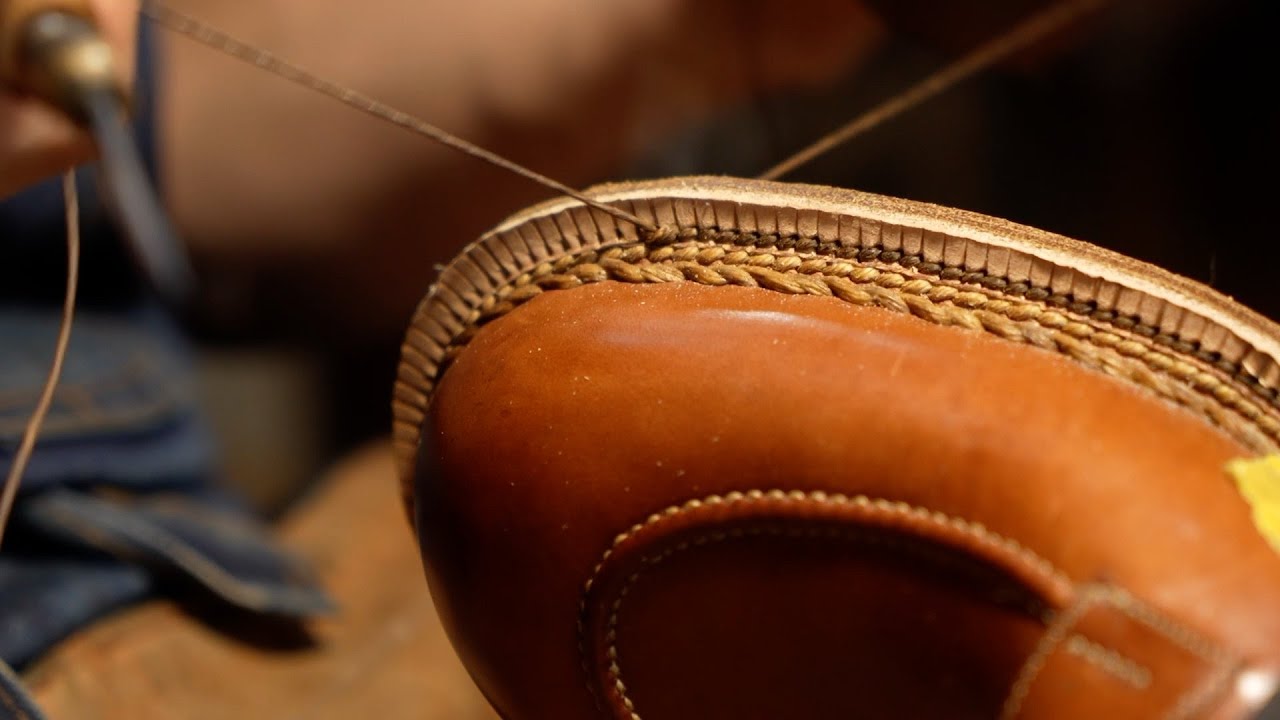
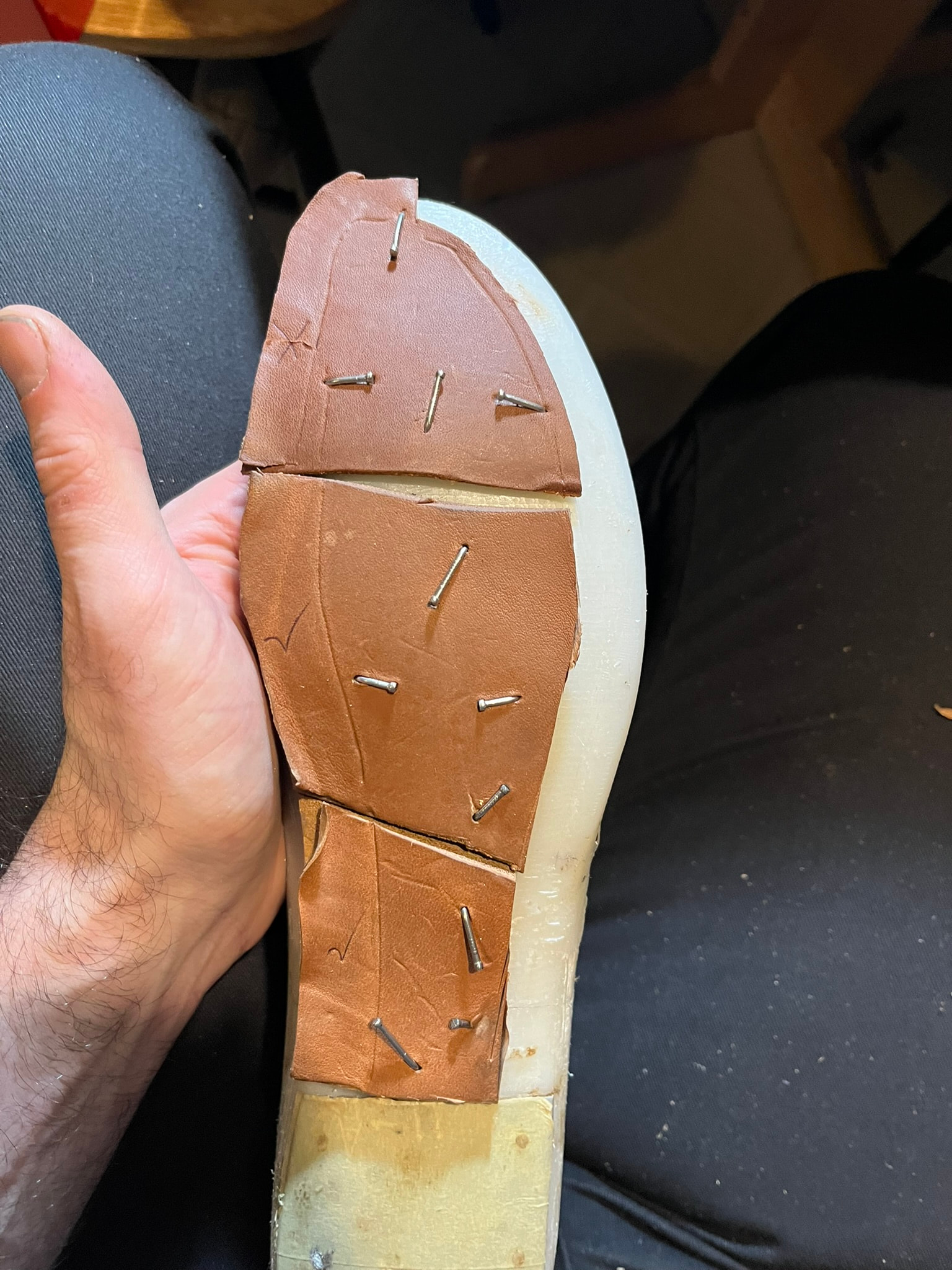
I noticed some pieces of scrap outsole leather in one of my bags the other day that seemed to fit together to make a forefoot shape, like puzzle pieces. So I dunked them in some water, wrapped them in a towel, and set myself a note to do a little flap cutting practice today.
A Practice Drill
My basic process was:
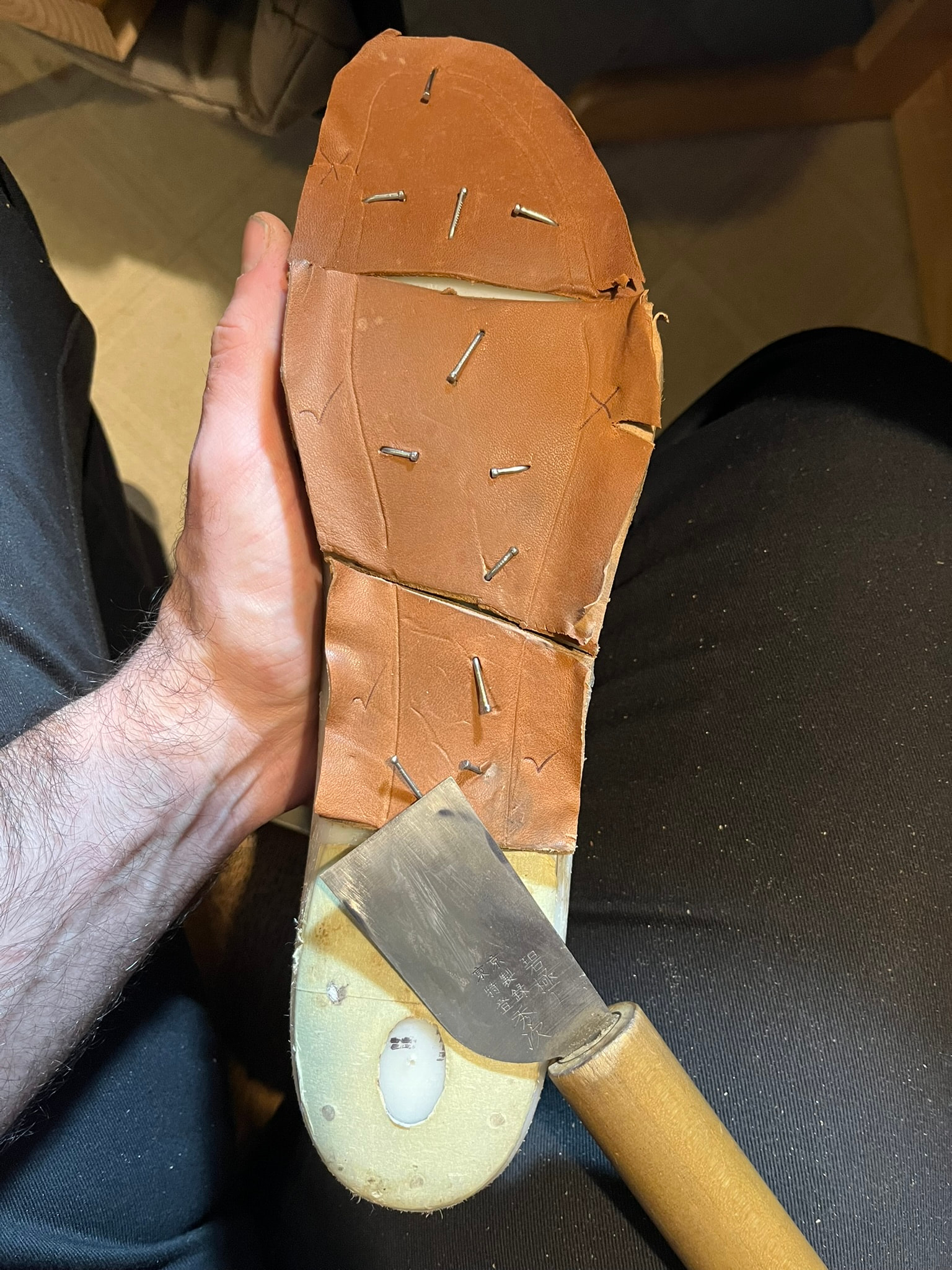
- Trim the pieces up to roughly cover the shank and forepart of a last I had.
- Tack them into place, trying to keep the tacks toward the center.
- Roughly whittle to the outsole shape of the last.
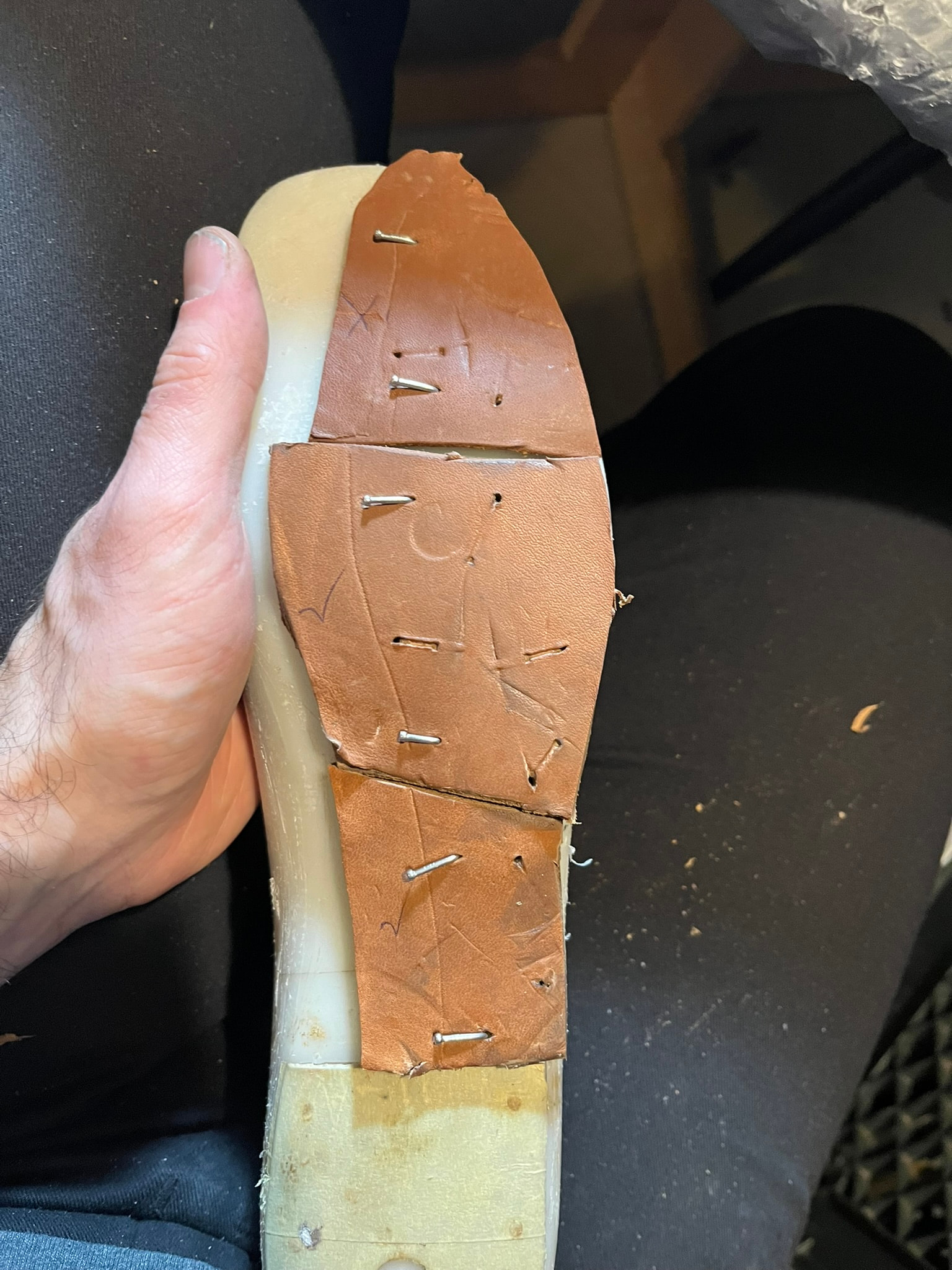
- Mark the inset of the flap from the outside edge with a compass. I did three quarters of an inch where I could and backed it down to half an inch where I had to avoid tacks.
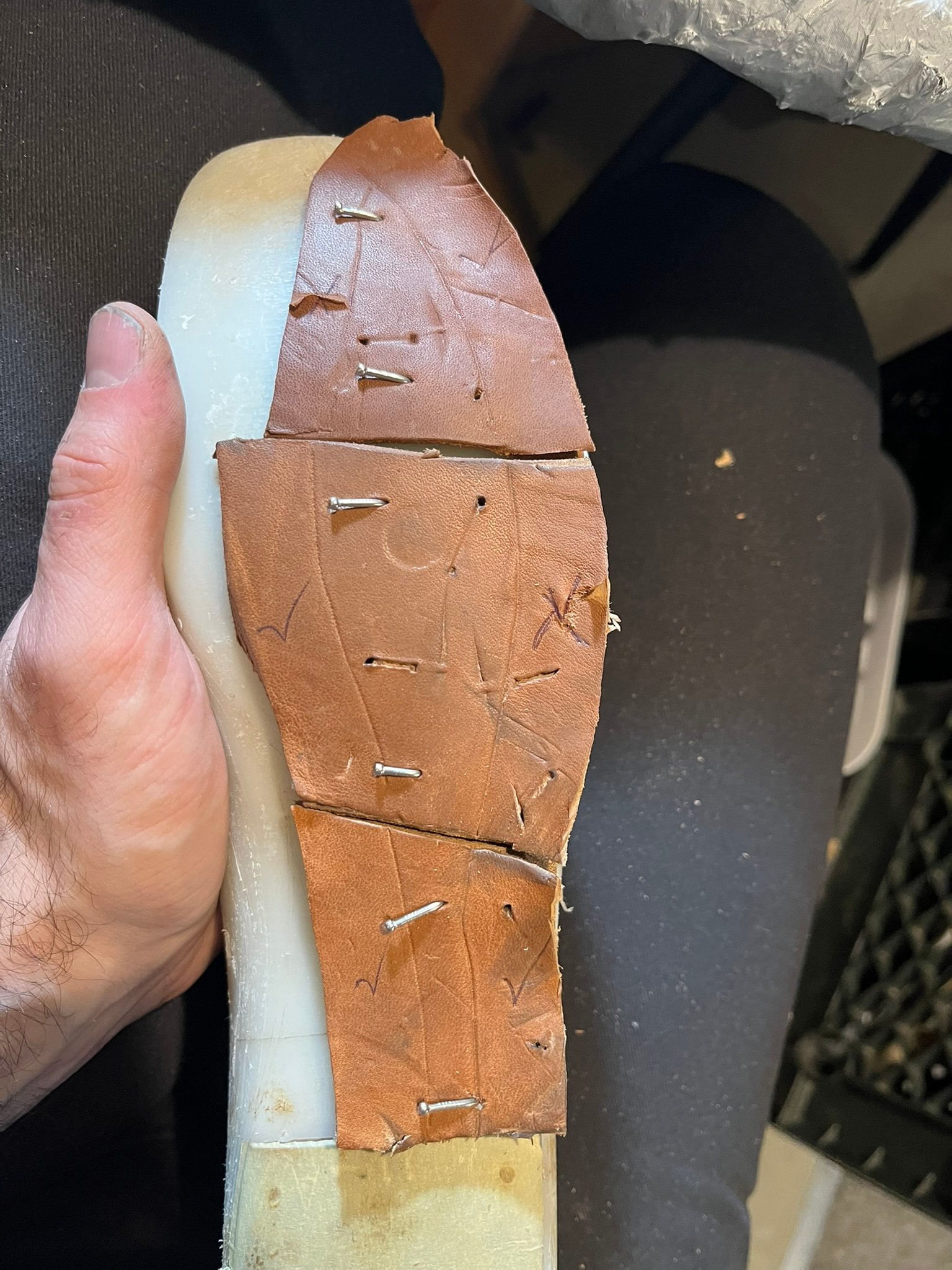
- Cut flaps. Mark clean and torn sections.
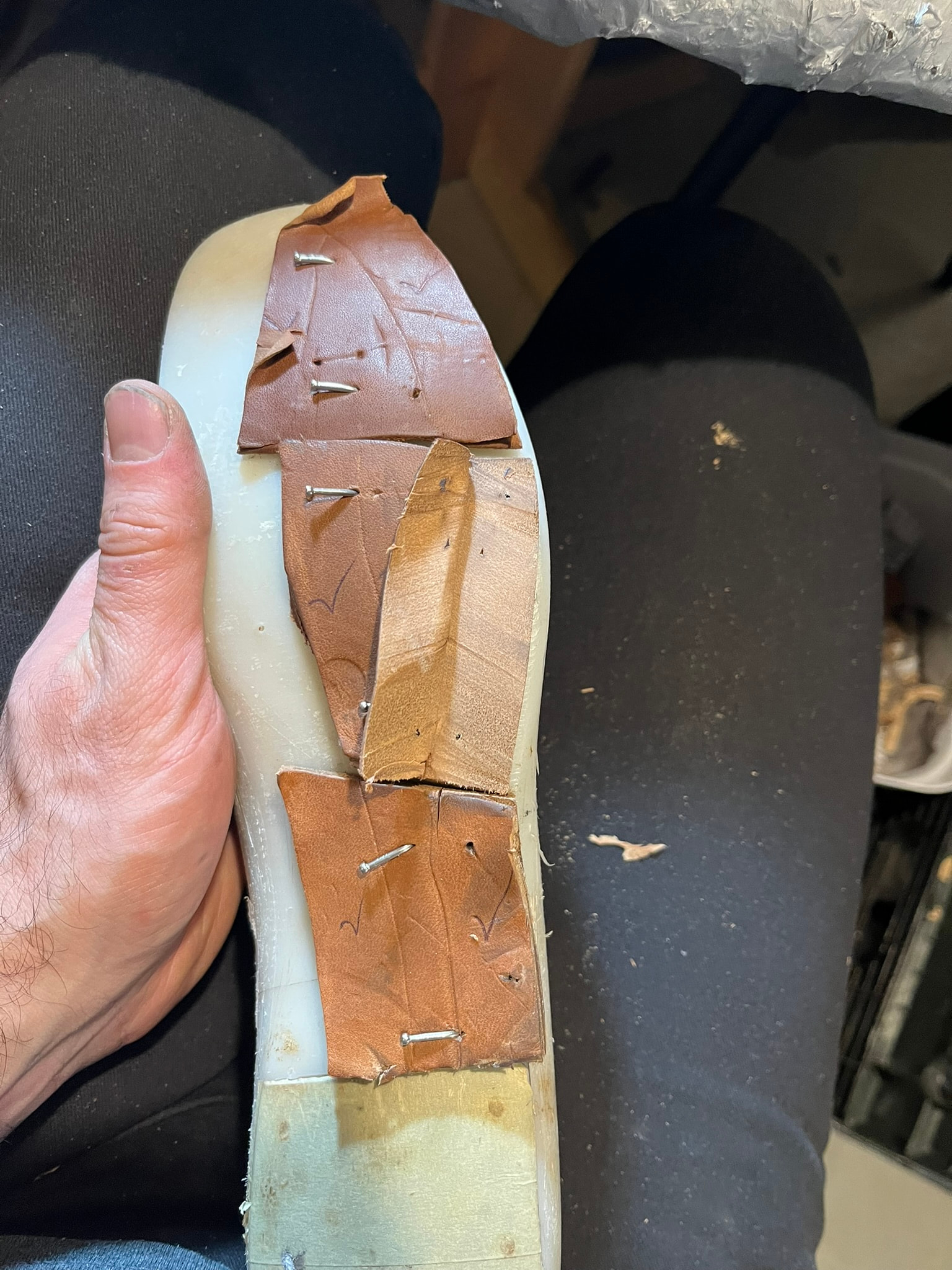
- Cut away the flapped parts on the side where I made more errors. Scoot the scrap pieces over to the featherline on that side, tack in place, mark for flaps, and repeat.
- Keep going until all the pieces are spent.
c
A Few Thoughts
I really appreciated getting a few rounds of practice in for casing leather just once.
Apart from making little jigs to polish awls, I don’t really have a great use for this smaller-than-heel-lift-size sole scrap pieces I’ve been hoarding. I’m glad to have finally found one.
I was doing this at night this time. It really helped to turn lamps on to get light from the front and the side, as well as from up top. Otherwise, my arms and even the knife threw dark shadows over where I was working.
I tried a few approaches and techniques. I seemed to have best results when I positioned the last so the edge of the sole I was cutting pointed straight up at me, revealing both a bit of the side of the sole and enough of the top of the sole that I could watch the grain ripple next to my scored line as I cut. That allowed me to avoid angling the knife too sharply downward into the sole, creating too thick a flap, as well as to avoid tilting the knife too far upward under the flap, creating a risk of cutting up through the grain by the scored line.
That said, most of my mistakes were cutting up through the grain on the outside, by the featherline rather than the scored depth mark. Keeping an eye on the side helps here.
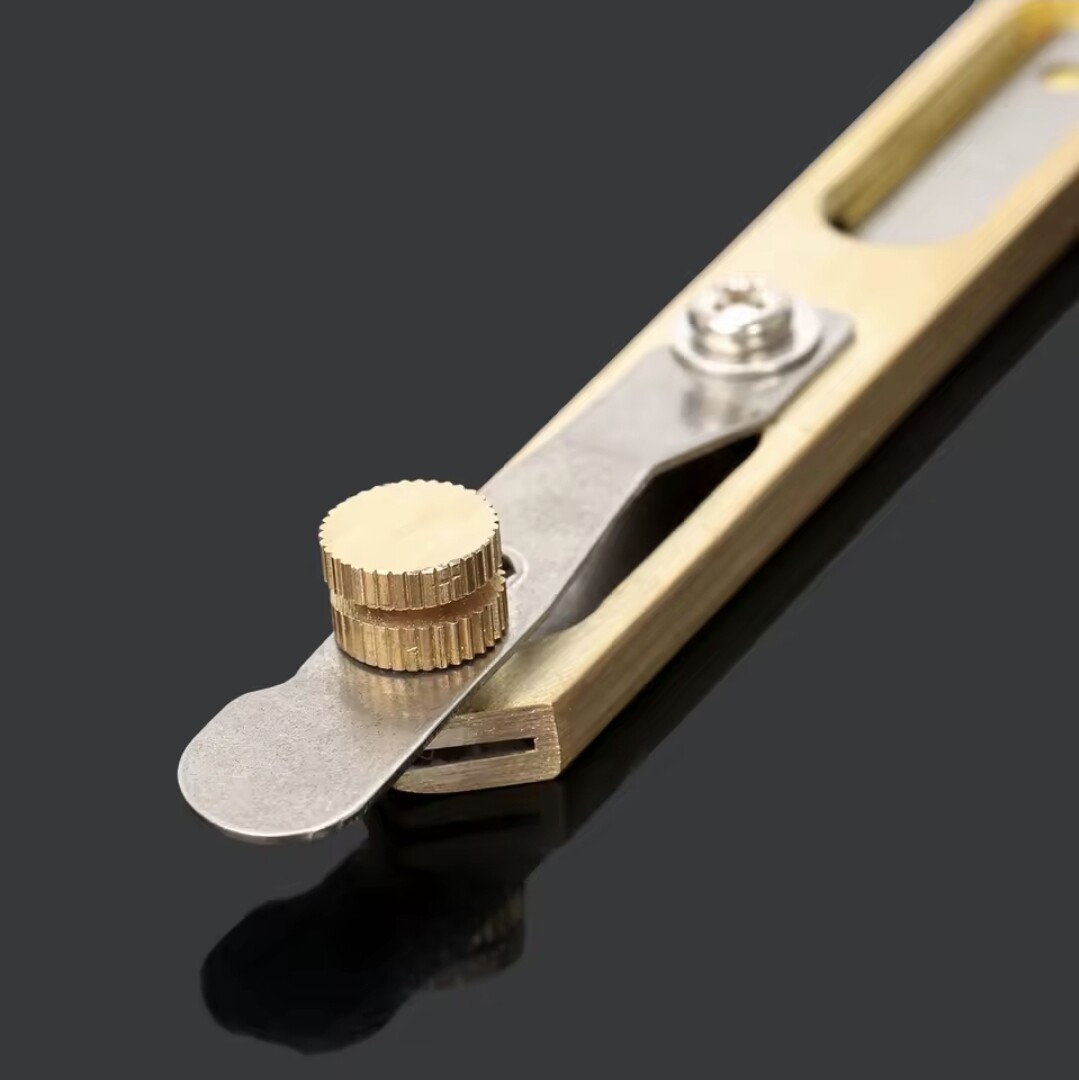
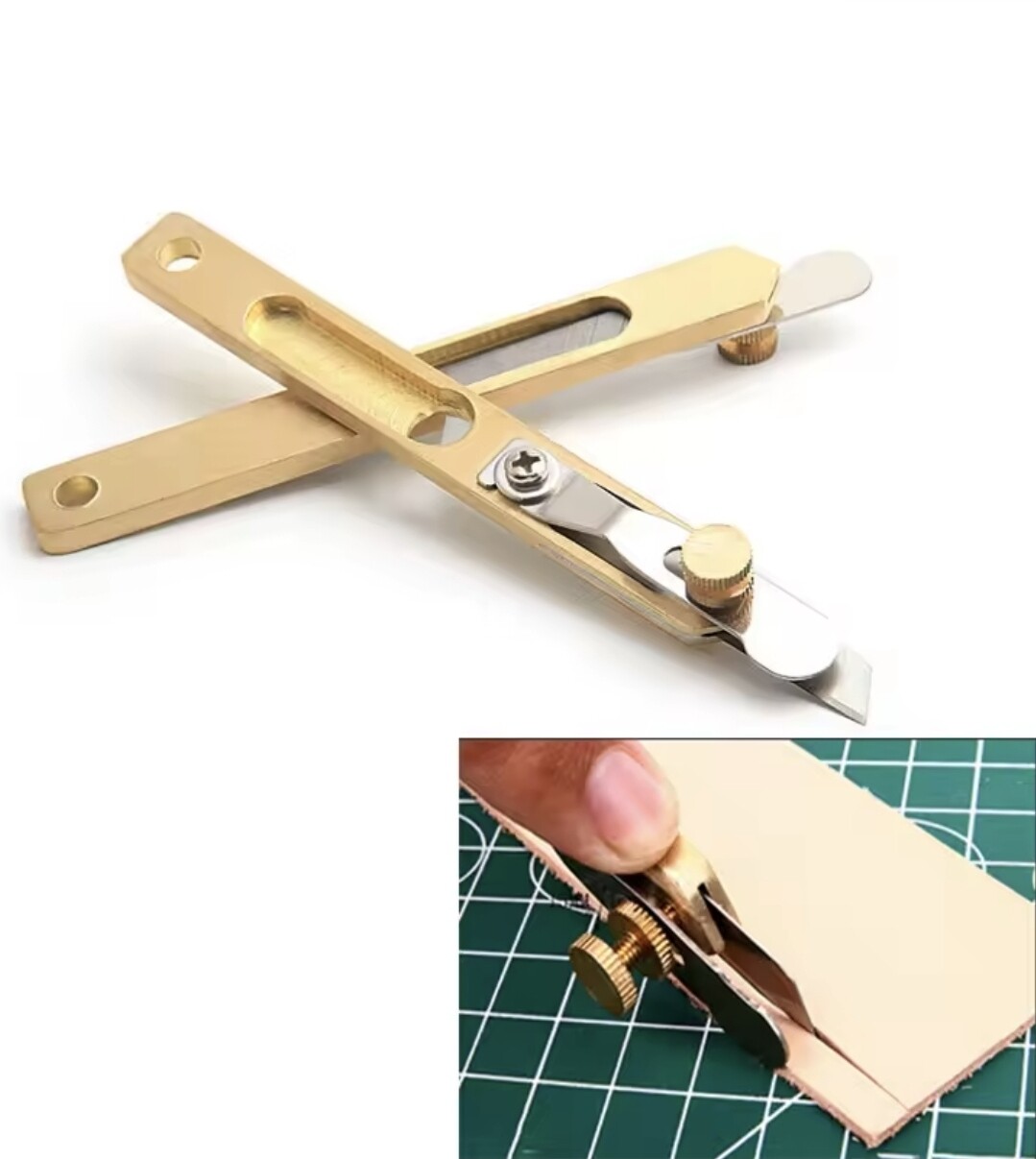
I used a Craft Sha Japanese style leather knife again. Specifically, I went back to the straight version I have, where the whole length of the cutting edge perpendicular to the long axis of the handle, rather than an “oblique” version where the edge is angled. The angled one makes more logical sense to me, since I hold the handle at an angle to the flap. But I seemed to have a better intuitive sense of where the point of the blade buried under the grain is with the straight version.
Stop, strop, and goal. I think I want to develop the habit of stropping every time I stop to reposition while doing this job. I can’t think of any other obvious, logical cue to stop cutting.
At times, I noticed myself kind of sawing or seesawing the blade back and forth, cutting mostly around one point of the edge of the other in succession. This enabled me to inch the blade forward, but created a kind of seashell-like pattern on the leather under the flap.
Other times, I’d simply pull the blade toward me along the path of the flap, cutting all along its edge at once. This was clearly smoother, but also felt much riskier. Sometimes it would cut further than I anticipated. I’d hit pots where resistance would build. Pushing hard enough to blow past that felt like a sure way to cut out or dive too deep.
I will have to rewatch some videos to get a better sense of what other makers do.