I’ve been doing some more rebuild and resole practice on factory shoes. I’m still a long way from the kinds of results I want to see, but I thought it might be fun to share some bullet points and hear from others.
Bent wire bristles sure do work well.
I’ve posted here earlier about making my own wire bristles from guitar string:
These have really served me well, working with Maine Thread 11-7 poly cord. Especially when I remember to make the taws long enough: tapering the seven stands at lengths about 2 inches between seems to work well.
Magnets make great wire bristle holders.
My stitching cycle smoothed out a ton when I started using pairs of neodymium magnets on my apron to hold my steel-wire bristles:
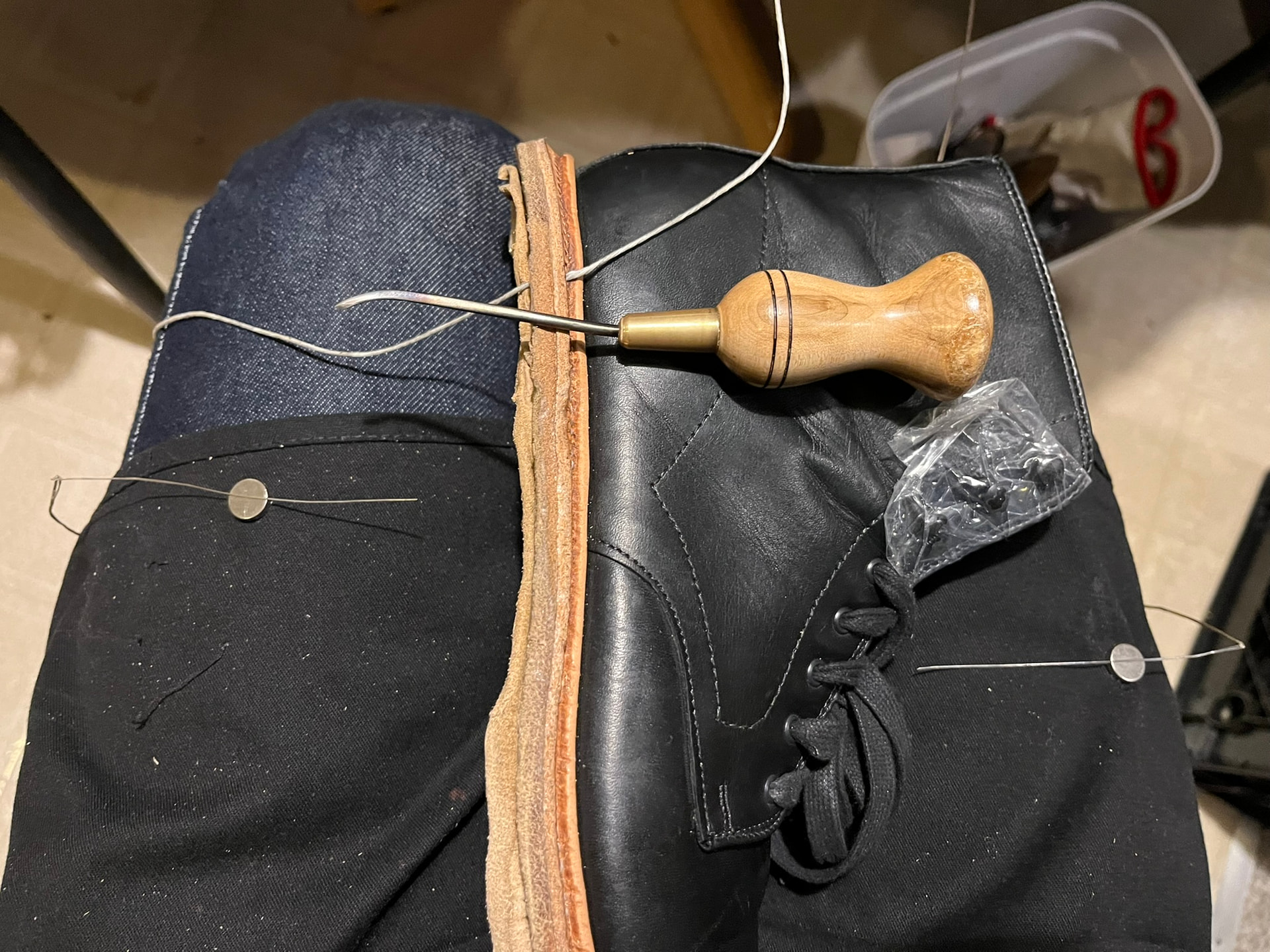
As long as I remember to put both bristles down on the magnets, this saves me having to put steel in my mouth or fish the bristles up from the floor every time.
If you keep a smartphone in a front pocket, try to remember to set it aside before doing this. Don’t hit your phone with neodymium magnets.
Checking Every Stitch
I’ve found that even setting the needles through the holes in the same way every time, I still need to check each stitch to make sure the threads cinch up with the right slant.
Rewaxing is important.
I’ve been using bleached beeswax for the thread and coad for the taws. Both will wear off toward the end of a long thread.
As soon as I see untangling on either thread, I rewax.
White thread gets dirty.
When stitching with white thread, I’ve found that I really can’t avoid it getting dirty toward the end of a long taper. It works out better to stick tapers about one arm span long and plan to splice.
Melting splicing knots can be tricky.
Stitching into what’s supposed to be a hidden channel, it’s easy to create visible bumps in the outsole flap by tying reef knots to join splices.
Tying a simple half knot, melting it, then pressing it into the groove can work, but it can be hard to melt the ends with a lighter without singing other stitches, the outsole, and the flap. I think a more precise melting tool, like a Thread Zap, might make sense here. It might also be possible to heat the tip of a metal tool like a screwdriver and use the heated points to melt the half knot.
Dick Anderson’s square awl has been great.
I used a Dick Anderson square awl with an XL haft and “big butt” or pommel this time. It’s working out great. Very happy with it.