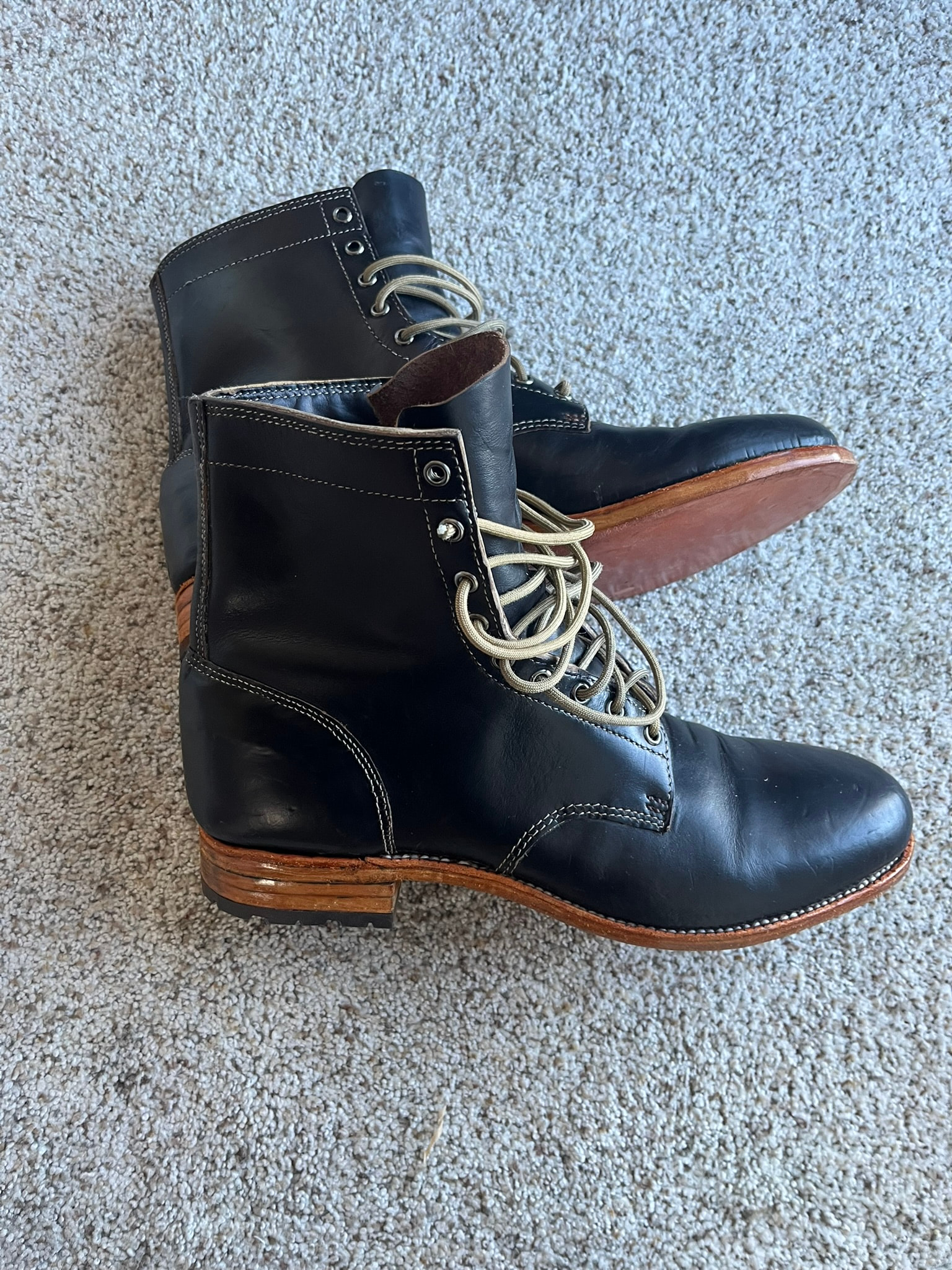
Pair 5: Mulligan Derby Boots

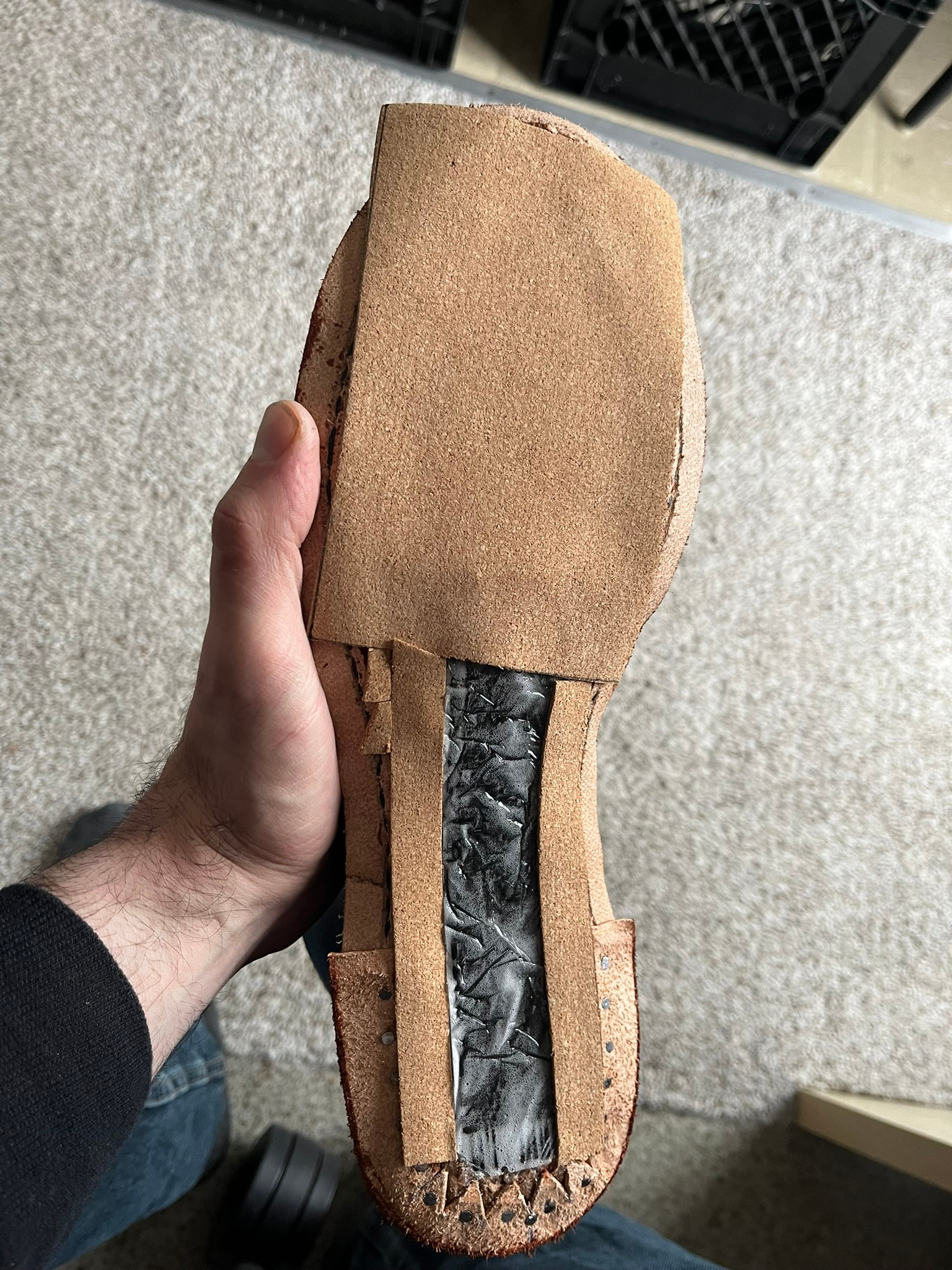
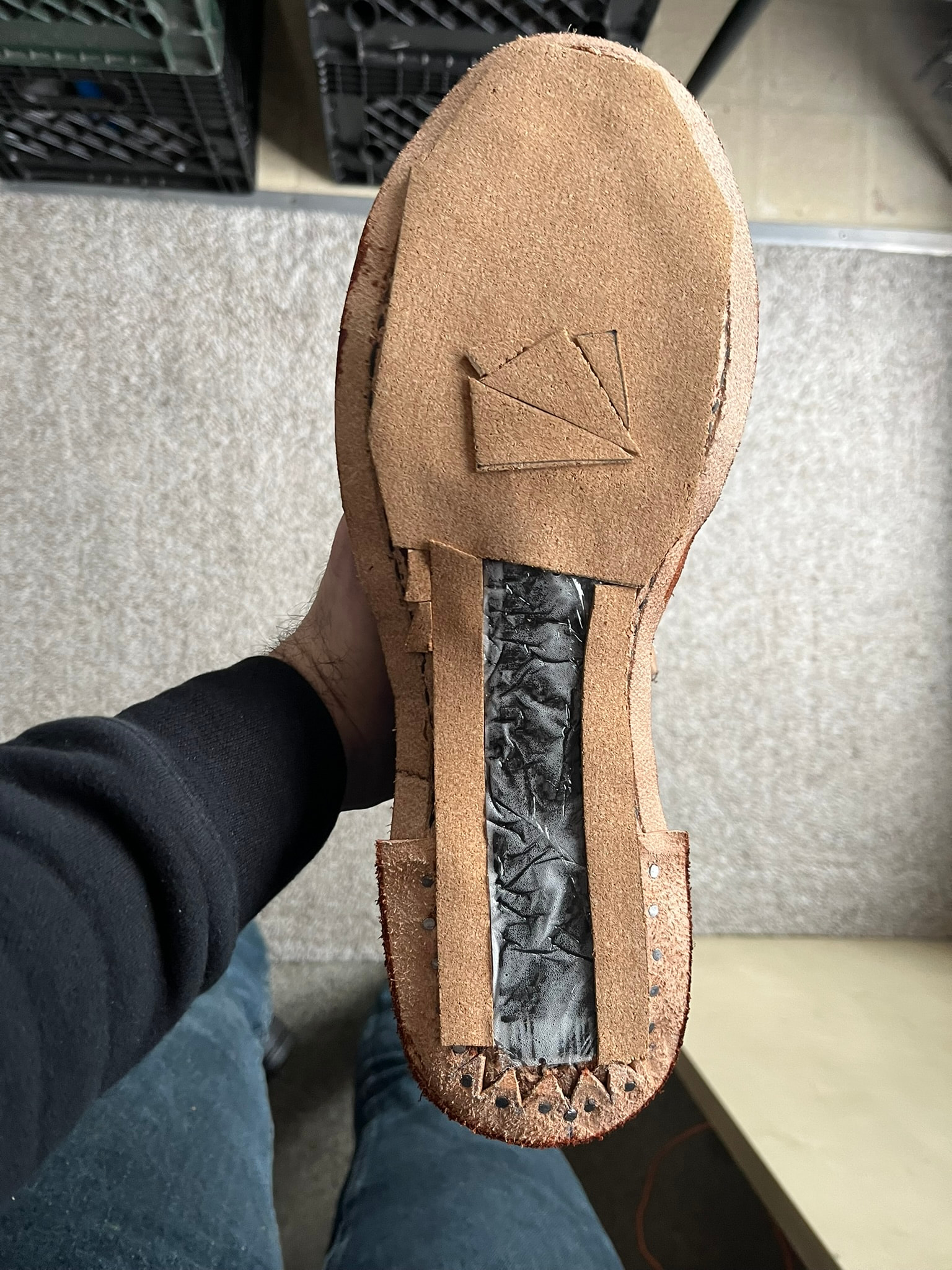
One of my carbon fiber shanks came out floppy. The other was fine.

I’m redoing the floppy one.

I used a scale to mix epoxy and hardener for the good shank the first time, but not the bad one. So I made sure to measure out again for the replacement.

I also used quite a bit more epoxy for the successful shank than the failed one. I went generous with epoxy again for the replacement.

Definitely need to get those ratios correct for epoxy.

There are other resins where you use a base resin and then a catalyst. In those cases, the ratio can drive the reaction speed, but aren’t as critical for a proper cure.

Another thing that can cause those issues is insufficient mixing. Also a good idea to have a second, clean mixing cup. Pour your two parts together into one cup and mix thoroughly. Then, pour that into the second clean up and mix again. That prevents issues where you have unmixed buildup on the walls that gets integrated later when you’re scraping out resin.

As far as excess resin, you generally want to go the other direction. Hand laid up composites will always have more resin than ideal from a strength standpoint. You’ll get better performance the more you can reduce the excess resin.

Great tips! I appreciate the mixing.

I’m optimistic I got mixing right…by manually stirring and scraping with a popsicle stick for five minutes straight. I probably overdid the amount of epoxy, but I did end up squeezing a lot out to the sides by pressing on the stack once laid up. Hopefully what’s left when I trim edges is mostly fiber.

You would be amazed how much some of that unmixed stuff will stick to the walls of the cup.

With wet layed up composites, it is pretty much impossible to get enough epoxy out. Once you get the air bubbles out so there aren’t dry spots, get everything out you can.

1 Like

I decided to buy some more generic cork sheet for filling from Amazon. But this time, I went with thinner ¼” sheet, and also with peel-and-stick backing.

I have found that I’ll need to double up and sand down for some areas. But overall, just being able to peel and stick was way more convenient.

Mistake: Don’t bevel the bottoms of outsoles under the heel seats.

I keep jumping to beveling the bottom edges of outsoles early, then forgetting that the leather heel stack will need to mate up with the sole without any gap.

Outseaming Screw-Up

I did a much better job spacing and positioning my outseaming holes on this pair. Naturally, the one glaring mistake I did make it right at the toe of one of the boots:

It’s always in the worst place when you do something like that.

Do you know what you did to make that mistake?

Not exactly.

I do have trouble getting clear, consistent lines with the fudge around toes. And I’m pretty sure I marked piercing points on those lines twice on this boot. I may have mistook an early prick mark for the final one.

These are off lasts and onto feet. I’ll have to get some proper pictures later this week, after I polish and iron.

The Good

I suspect I’m starting to get the fit on these lasts dialed in pretty good. I haven’t walked these through town yet, but “out of the box”—there is no box—they feel better than any I’ve done so far.

I also have high hopes for getting the facing gap that I wanted. It’s pretty close to as-designed over my insteps. Over the ankles they’re a bit wide, but I’m expecting a little stretch from the Chromexcel.

Mistake: Lasting tacks through heel rands.

When I first delasted these, I found all the nails I used to mount the heel rands sticking up into the shaft. They came through outside the edges of of the insoles in the heel seats, completely missing also the steel plates on the lasts. A couple stuck out as much as a quarter of an inch, poking out through the upper lining.

I worried this might have ruined the boots, but in the end I was able to clip with pincers and peen over with a punch. I can put them on with out impaling myself, even without sock liners.

The decision to nail the rands was on the spur of the moment—always a bad sign for me. Then, clearly, I picked nails that were far too long. And I either nailed them in too far out or angled them inappropriately outward.

Basically, I missed.

Mistake: Wobbles around the heel seat.

I decided to try saddle stitching the heel seats of the uppers on these, carving a holdfast to take them. Then I trimmed the uppers right to the holdfast, like I did through the forepart.

That turned out to play particularly badly with the thick sole leather heel counters I put in these. As a result, I’ve got one grinning stitch and some visible waviness around parts, above the rands.

I’m fairly confident all this will fall down and settle out with wear. But they’re not looking pretty here right off the lasts.

Heels and Edges Notes

I originally thought I’d dye to match the burgundy coloring of the welt, but decided that would be too much. I eventually tried black, but almost immediately regretted it and sanded it away. That’s produced a kind of wood-grain effect in the end product, which I redyed with Fiebing’s “Saddle Tan” on the edges and Fiebing’s 228 bottom stain on the soles.

I’m still not entirely happy with a tan-ish “natural” color dye, but the Fiebing’s “saddle tan” is as close as I’ve got. I think I might be able to dilute it a bit and get the kind of shade I want. I’ve been trying to match the color of some premade storm welt that I bought from the Baltors. It is close.

I tried the bottom stain because I admire so many cowboy makers who use it and spotted a cheap tub for sale from Panhandle Leather. It’s only my second time using now, but it steel feels—and smells—like a pretty strange product. Apart from a few video examples of people actually using it, I haven’t been able to find much of any product information online. How does it differ from the other dyes? Are there names for the various colors corresponding to the different product numbers? I dunno.

It definitely helps to apply in swirling, circular motions. It’s really easy to create streaks with it, despite how little dyestuff it seems to leave with each coat.
I have tried the Fiebing’s bottom stain on veg tan scraps and I agree with your points on the smell. I couldn’t find an SDS online but Lee Miller used it without a respirator in his series with Kirby Allison. I also am not really a fan of how dark the bottom stain is. I found the sole stain Ken Hishinuma uses from an old video. Mamoru and material box sell it. Unfortunately, there isn’t much information on what it is made of so I didn’t want to risk any shipping issues.
I wonder if anyone has tried using things like tokonole or CMC. I found a video that compares shoe polish with funori. It’s a shame funori is so expensive here in the states, it gives off my favorite “natural” looking soles.

It never struck me as a fume hazard. Seems like a water-based gel.

I’ll e-mail Fiebing’s and ask for info and a safety data sheet.

1 Like

For anyone else who finds this topic, here’s the part of Lee Miller’s video that @lexar4h1 mentioned:

1 Like

My first pair of boots my teacher had me use sc Johnson wax on the bottom. Darkened slightly and shined up nice

They look good! I like the toe shape on these

1 Like

The paste wax in the yellow tin with the red stripe?

I do find myself attracted to pretty minimal, aniline edges and bottoms. I’m just not good enough at shaping, smoothing, and burnishing yet to make them look good.

Thanks! These are on a pair of the Greg Carmack roper lasts again, but with quite a bit of build up from the balls forward.

Yep in fact I don’t think it’s made any more but I bought a couple deadstock tins in case I wanted to use it again. Easy to wipe on and polishes well. I suppose it’s mostly paraffin

I found this safety data sheet for SC Johnson wax online.

2019-12-17 SC Johnson Paste Wax Safety Data Sheet.pdf (169.5 KB)

Upshot: 60–100% stoddard solvent, 10–30% “paraffin waxes and hydrocarbon waxes”. I believe "stoddard solvent” is just a particular blend of mineral spirits.

If paraffin were undesirable, I’m sure one could blitz together beeswax and mineral spirits, too. For a golden tinge, unfiltered beeswax might do it.

I do like the idea of slightly darkening the leather. The JR outsoles are beautiful, but I’m reliably buying and using cheaper stuff that’s not so appealing.

1 Like