Not probably what you’re looking for but I can add that the Ivy style legend Barrie Ltd Booters, near Yale and next door to J. Press, was the origin of the last that Alden eventually licensed. you can see them in this picture out of the classic “Take Ivy”
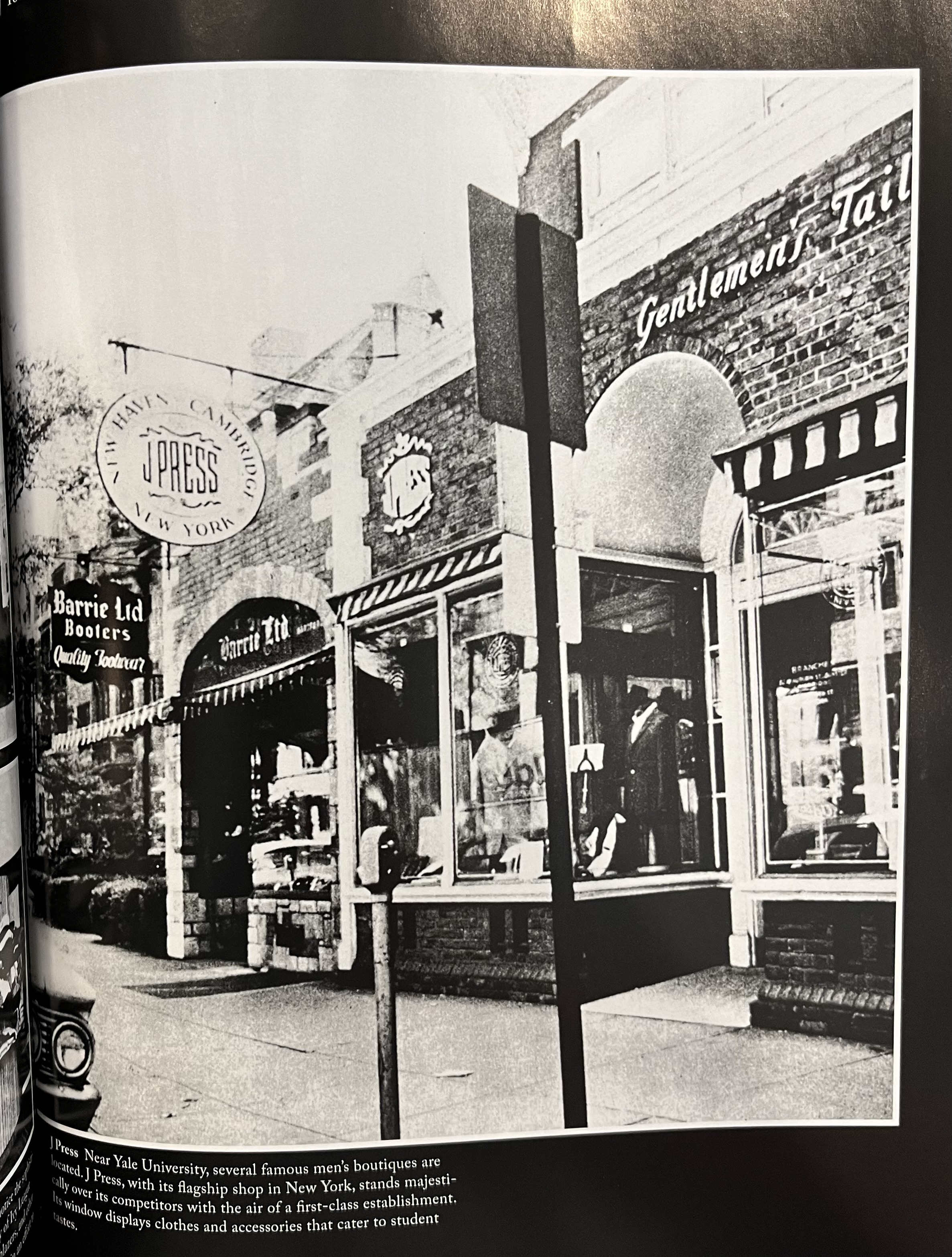
Interesting! Any idea where you may have read or heard about that last coming from Barrie Booters?
I’m convinced there’s been a whole, hidden world of last licensing for quite some time. But it’s very hard to find public signs of it ongoing. There’s clearly sharing of lasts that don’t have owners, or variants of them, like the Munson. But the only live example of an ongoing, publicized licensing deal I can think of is Nicks selling boots on Parkhurst’s 602 last:
Soap or other Detergents/surfactants (like castile, glycerin) are used as wetting agents, making leather wet faster and stay wet longer and stay pliable. In my spray bottle (now a fancy micro-spray bottle!) for wetting uppers for lasting, and soles for sewing (and of course for carving and tooling) i keep water with 1:10 parts Pro-Carv casing concentrate, which is already just dilute glycerin and coconut derived soap (like the laurel sulfates in dawn and most shampoos). It’s to make it where you dont have to leave tooling leather casing in a grocery sack all night to loosen it up to take the carving and tooling. But works for soles too, and also substitutes for shoe stretch.
1 Like
Oof i cant remember where I read that originally except somewhere during my brief alden obsession which i think was just a rite of passage when learning about the gyw world 
I’ll try to find a source
1 Like
This is the first I’m hearing about wetting agents!
I might give it a go with dilute castille soap.
Soap, detergent, wetting agent, foaming agent, emulsifier, surfactant - all just use-dependent names for the same concept chemically, long organic molecules that act like oils on one end and salts or alcohols on the other therefore can live at the boundary of nonpolar and polar substances, ie oil and water, and allow them to bond or intermix peacefully. Tanned leather has a lot of its hydrogen bonding sites tied up by tannins so water needs a little help or time to wedge its way between the collagen bundles to lubricate them so they can move independently
1 Like
Ok heres a clue, and it would make more sense from this that Alden designed the Barrie last to their specs to make loafers for them:
https://classicshoesformen.com/the-collection/vintage-barrie-ltd-horween-shell-cordovan-tassel-loafer-44d-us-10-5d/
Edit - also super interesting: https://www.askandyaboutclothes.com/threads/a-trip-through-ivy-league-footwear-with-barrie-ltd-pre-war.107335/
1 Like
Discovering Seam Standards
Thanks largely to garmenco.com’s Stitch and Seam Guide, I am beginning to add entries and diagrams for various standardized seam classes and types. I’ve been focusing mostly on ASTM D6193 so far, but also have my eye on ISO 4916 / Indian Standard 11161.
More PDF links
I’ve started going through and adding more entries on books, as well as links to Internet Archive, Google Books, and other repositories with copies of books in the public domain.
I probably haven’t done enough promoting of “category entries” like the books page there:
Appalachian Shoemaker
I found an interesting article on an Appalachian shoemaker making pully pegged roughout Derby brogans in book 6 of a journal called Foxfire. Added some notes to the wiki.. There are some great photos of homemade tools, wood peg splitting, and patterns in there. It was fun seeing how some of the maker’s terminology aligned or differed from what I’ve read and heard.
1 Like
Composite Stitches
I was able to replace one the entry names that I had to make up in order to have something to call the entry:
It turns out there is an excellent public database of embroidery stitches maintained by the Royal School of Needlework:
They define “composite stitch” and keep an updated list of the ones their site identifies and teaches:
They have identified a number of stitches that I first saw in shoemaking, rather than embroidery:
There is also a consistent vocabulary here: “threaded” and “whipped”. There are also variants: single-threaded, double-threaded, and so on.
They don’t have entries for threaded or whipped shoemaker/cordwainer/saddle stitches or lockstitches. But they do have their own entry for the base saddle stitch, which they see as two running stitches sewn in succession, rather than a double-needle operation:
I am not about to become a needlepoint man. But there is clearly some awesome stuff going on over in that world:

Icons for Freely Downloadable Sources
I’ve added green download icons after links to entries on sources that I’ve marked as downloadable:
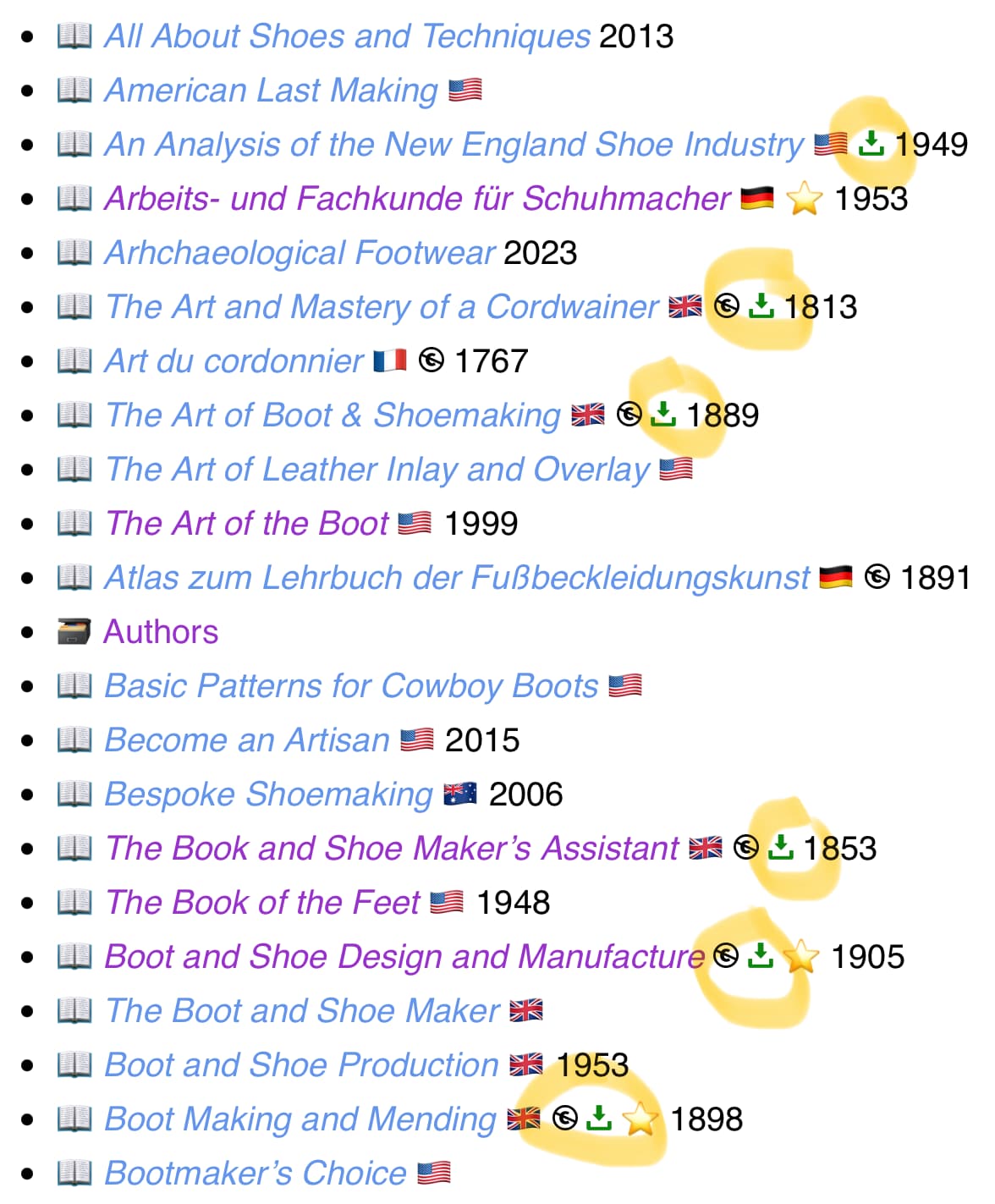
These are mostly links to Internet Archive, Google Books, and HCC’s library.
1 Like
Guide for downloading PDFs from repositories.
The books page now links to a guide, with screenshots, for downloading PDFs from Google Books and Internet Archive.
1 Like
Tacks and Nails
I’ve been trying to get my head around the differences between the various tacks and nails D.B. Gurney offer. They’ve never published a catalog, and their own site is really scant on detail, so it’s been a challenge.
It turns out a number of the variety names they use actually go way back to at least the 1930s, when the federal Bureau of Standards published guidance encouraging nail and tack makers to standardize and streamline their product lines. There are also a bunch of early 20th century wartime price-control and tariff schedules specifying prices and rates for “hand shoe tacks”, “extra iron clinching nails”, and other varieties specific to shoe making and repair. This later became standard ASTM F1667.
The upshots seem to be that:
- “Hand Shoe Tacks” are called so in distinction from machine shoe tacks
- Hand Shoe Tacks are made of slightly thicker plate, and with slightly larger heads, than cut clinching nails.
- “Brass Clinching Nails” are basically the same shape as “Extra Iron Clinching Nails”.
- “Bulldog” was once a trademark, and may now belong to a Chicago company that’s importing production, but seems to be used by a bunch of makers left over. It’s on some Gurney boxes.
- “Soling Nails” have oval heads, while Hand Shoe Tacks and Extra Iron Clinching Nails have round heads that get squared off on two parallel sides.
I don’t know what’s “Extra” about “Extra Iron Clinching Nails”. Their don’t seem to have been “regular clinching nails” in any source I can find.
New entry on a US-based shoemaker offering classes:
I was able to add a short entry on another US-based model maker:
This one came about in a particularly fun way: Frank’s daughter, now in her seventies, e-mailed me some memories about him, as well as a pic of a journal article about him.
I wasn’t aware of his Custom Last Shoe Company or their work for the Veterans Administration. I also didn’t think about Dr. Scholl’s as a company that would employ a model maker.
This wasn’t any kind of deep craft tutorial, but I enjoyed watching it, and picked up some new notes on different terminology than I’d seen before:
https://www.youtube.com/watch?v=pXHvlnMGyR0
For example, they call their chanstitch Black stitcher a “beaking machine”, and a slip of leather added as bottom fill over the forepart for shape a “slip welt”.
Andrew Gadd Videos
Thanks to forum friends here, I’ve added short notes on the videos Andrew Gadd posted a decade back. They’re all linked on his new wiki page:
Andrew mentioned in comments to one of his videos that he’d been at the craft for more than 30 years. That’s about all that I know about him at this point. Online searches turned up a forum post mentioning that he may have been a West End outworker. But I wasn’t able to confirm.
I’m definitely impressed by how fluidly he works in his videos. They’re all short. I’ve really enjoyed watching them all.
1 Like