Lisa’s Stocking Unwaxed Maine Thread
I just added a mention on unwaxed section of the Maine Thread entry that @Customboots is now stocking unwaxed pound spools of 11-7 and 8-5:
I just added a mention on unwaxed section of the Maine Thread entry that @Customboots is now stocking unwaxed pound spools of 11-7 and 8-5:
I’ve split off a new entry, “Heel Seam”, specifically for seams in quarters and heel counter covers that cross the featherline at the back, visible on the outsides of finished shoes. I’ve marked this as another made-up name, to distinguish from “Backseam”.
I don’t see consistent terminology on this, but it seems pretty clear to me that darts in these patterns, and the seams to close them, are made to ease curving the upper down and under the backparts of the lasts. Some makers don’t use them. Perhaps most notably the PNW logging boot makers. But those makers often also wet last.
Chad Little in Fort Worth has put out a couple new videos in the holiday season. I particularly enjoyed this one of him showing his unique welting style, timing himself for speed:
Man, that looks like a super convenient way to do it…
As @thenewreligion and I were typing about earlier, there is definitely something to the combo of newfangled super thread and lockstitching. The redundancy of intertwined running stitches just doesn’t matter that much if each thread is stronger than literally everything else around it. Your worry becomes the thread sawing its way through the sole leather.
It’s hard to romanticize plastic. I’ve learned the German word for braided poly is literally “trout cord”, as in heavy duty fishing line. Not very old-worldy, artisanal, or nostalgic.
But the break strength is incredible, it lays flat, it’s easy to bind needles if you want, and there’s no reason I can see not to use prewaxed. Maine Thread now make braided domestically, for those of us in the USA.
Maine Thread gives breaking strengths for its braided cord of 32 lbs up to 68 lbs for the 0.040”/1mm. Ritza 25 goes up to 1.2, 1.5, 1.4, even 1.7mm. It’s hard to find reliable material properties charts for natural fibers, since they’re not nearly as consistent as plastic. But all the figures I’ve seen for linen and help products fall well short.
Btw he’s talking about mannie lustiche there, making 8 pair a month in his 70’s
Any info on Mannie around? Sounds like quite the character. I don’t have any notes on his work.
He posts his stuff on Facebook regularly and very active in “the official bootmaking” group along with Chad who is his protege of sorts. That’s where Chad learned things like staking side seams before sewing them. Also see Diamond dog livery
@Carsten inspired me to take some more photos about knives and add them.
There’s now a nice line-up photo of knives showing a spectrum from edge-perpendicular to edge-parallel on the respective knife category pages:
I also took some photos of straight and curved TINA knives, set up for a mock skiving task, from the side. This helps to show the use of the curved versions:
I’ve added a bunch of stub entries for books I hadn’t heard of to the books list today.
I’ve just identified another sole leather tannery in France:
Reddit user Aedronics gave me permission to include two x-rays he took of a Nicks boot on my entry for clinching nails. Great shots!
I finally succumbed and added entries for a common terms for toe shapes that I see around. Hopefully I’ll also be inspired to take a few photos of boots and shoes I have around representing those styles.
I’ve been hesitant to add these kinds of entries. Makers, salespeople, and consumers all seem to use some of these terms in really different ways, and it’s not clear to me that I have anything offer in a sharper taxonomy, or even if anyone would really benefit from such a thing.
On the other hand, toe shape does come up a lot in other entries, and I’ll be glad to have entries to link to that can serve as waypoints to other entries.
just added a short page on the polish maker.
Their website has a great page showing photos of different welt and outseam styles side by side:
https://kielman.pl/en/rodzaje-szycia/
If you click an image it will show notes about it at the top.
I’ve added short entries on two Japanese-language shoemaking books that I see referenced a lot:
I’ve also added an entry on an eBook by an enthusiast surveying bespoke makers worldwide, which is now also available in English translation as an Amazon e-book:
All of these are indexed on the category page for Japanese language resources, which would be a lot longer if I’d properly tagged all the videos from Ken Hishinuma and Kazuma Nishimura that I have notes. on
I have the Chinese translation of The Book of Men’s Shoe Making. At first I asked chatGPT to write code to do a translation to english but it did not work at all. I have since discovered that the iphone translate app has a feature that directly translates text and overlays over the original. The translations aren’t great but it’s enough to understand the main points. I believe google has a similar app.
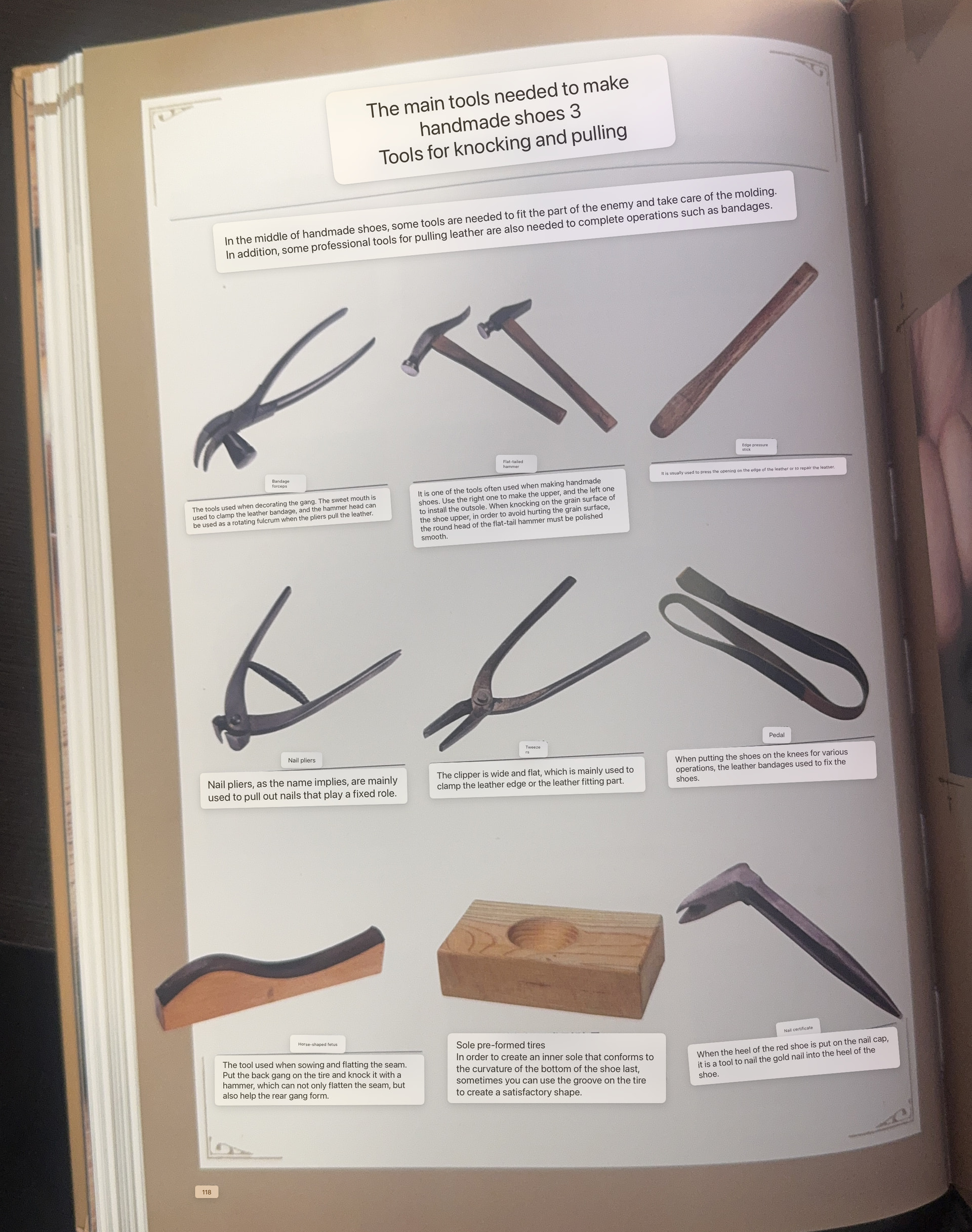
Here is an example page:
Nice tips! I hadn’t heard about a Chinese translation.
I’ve really tried to avoid falling into “what’s the correct term” traps in writing up shoemaking.wiki. I am and should be very humble about what I publish there—I’m no authority—but I know others are looking there for info. I really don’t want to be the source of any terminology purism, either!
Still, especially as I’ve focused more on finer points of handwelting, I’ve found myself coming up with names where I don’t have them. For examples:
I’ve been marking entries with names that I made up myself, rather than hearing from another maker or seeing in writing, since the get-go. They all get special call-outs at the top, so readers get warning that the name is my own invention. But I’ve only just added an index page to list all those entries: