Struggling with Pegging

I’m getting in more practice, but still not quite pleased with my pegging. Even when the pegs are just structural, like in a heel stack, rather than exposed, as through a shank.

I’d love to read about what others are doing, what’s working, and what’s not.

What I’ve tried so far.

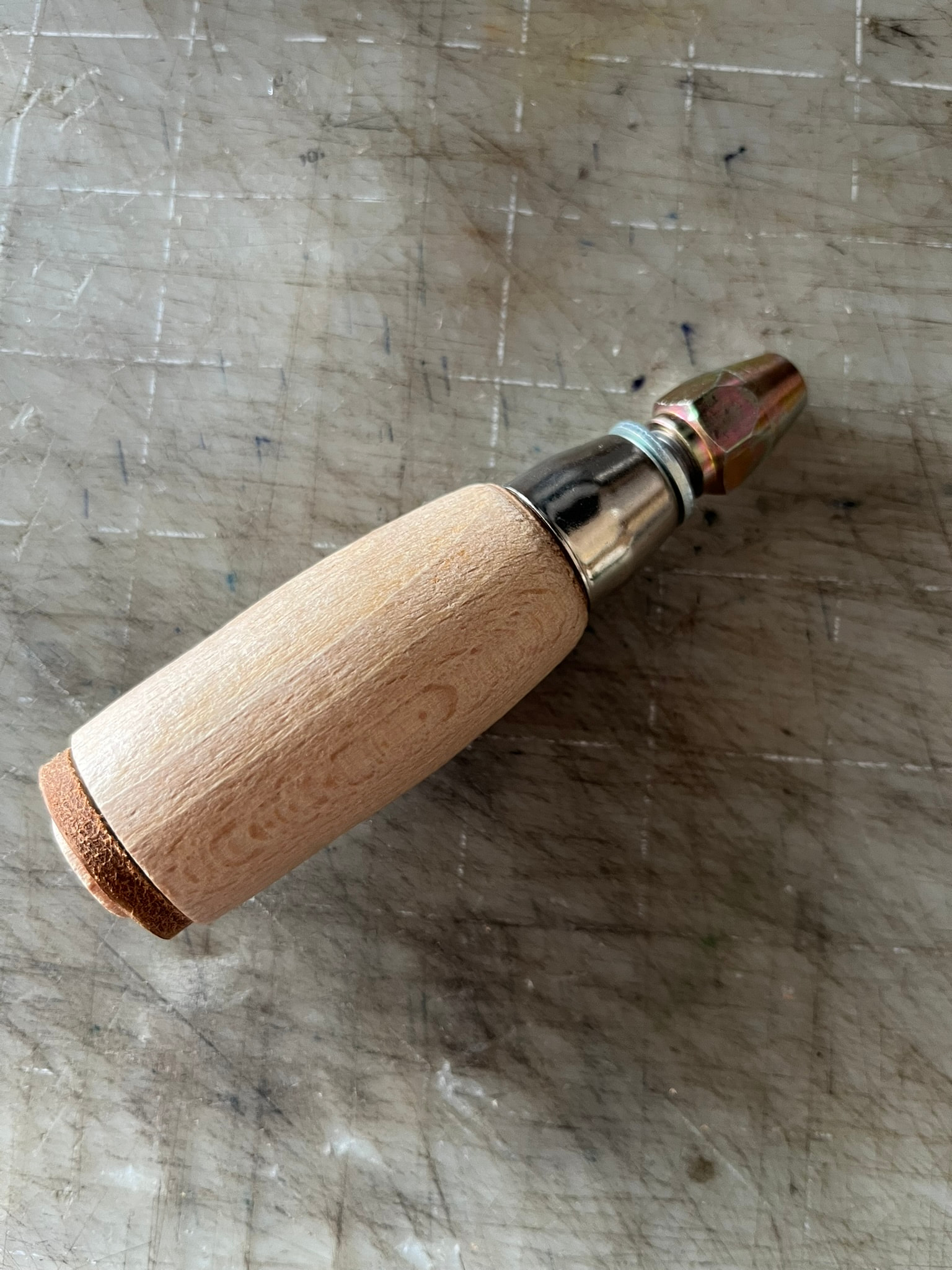
I’ve been using a C.S. Osborne number 143 pegging awl haft so far. I’ve glued two extra rounds of scrap leather on top of the two that came with it, mostly to lengthen it a bit for my gangly hand.

The only issue I’ve had with the haft is that it won’t hold thinner blades, like those I threw into an order from Viktor Starko. It will hold them fine driving in, but when twisting out, they slide out of the collet.

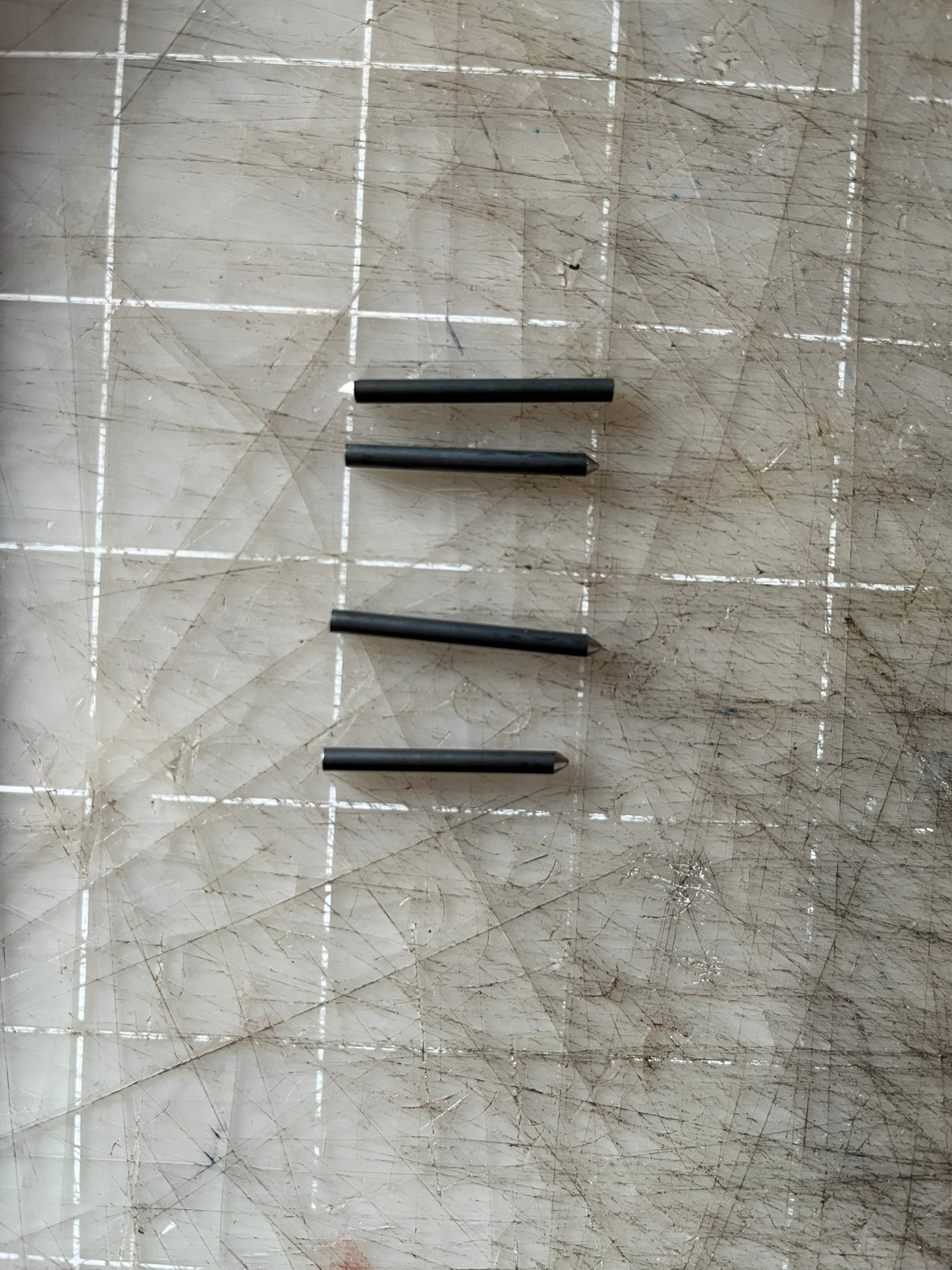
As a result, I’ve mostly been working with blades from @Customboots, listed as “40mm pegging” here. I’m not sure who made those or where they come from. They’re much longer than the blades Starko sold me, with conical tips that taper much further along their length. They seem to be made from 2mm square rod, tapered gradually to 1mm round, with fine conical tips then ground at the very points.

Wine corks remain my favorite way to store awl blades:
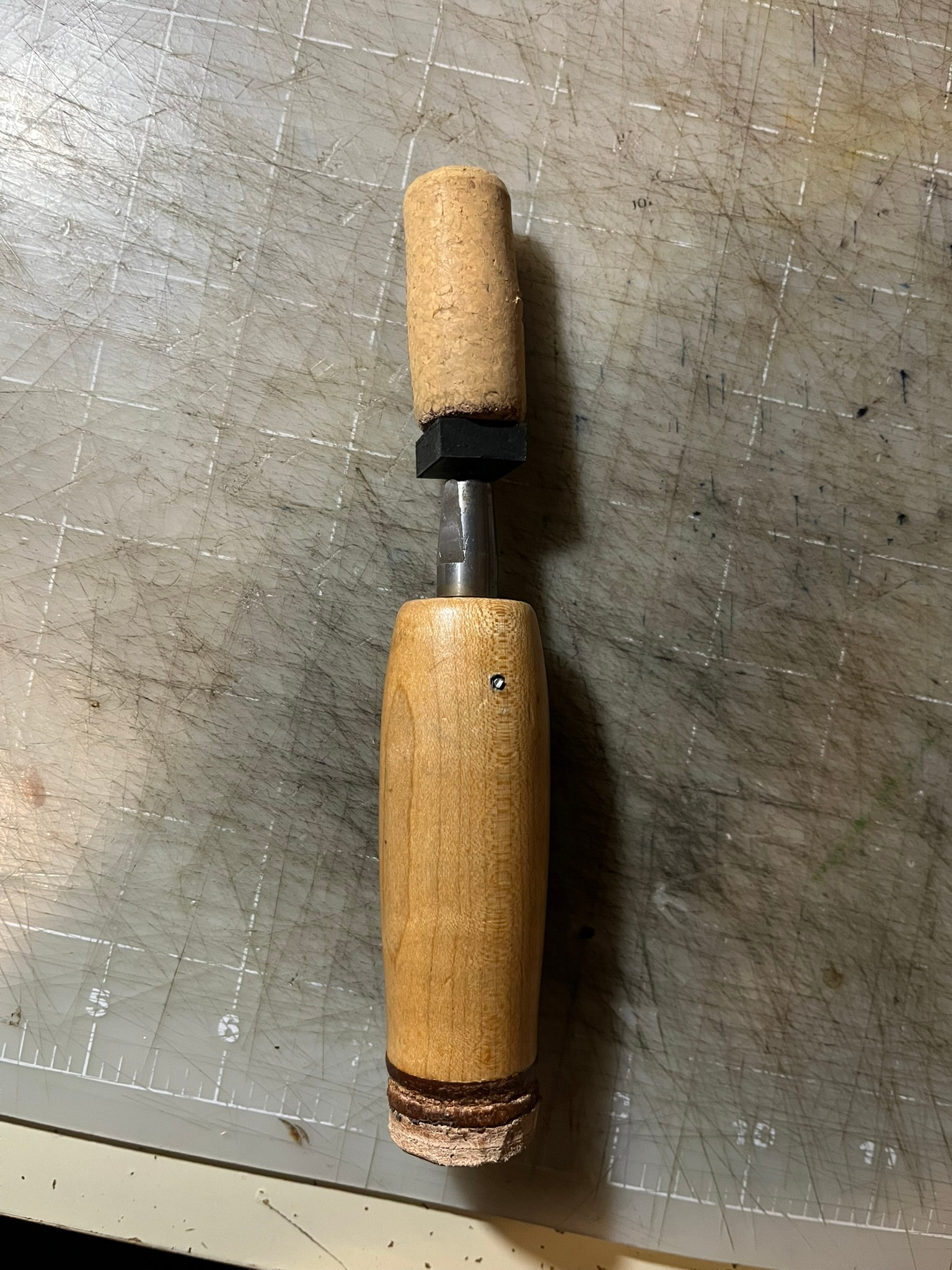
The black square under it one of the little rubber bumpers I keep to stack up as stoppers. I cut a handful from quarter-inch rubber sheet. They’ve worked well.

For pegs, I’ve mostly been making my own, documenting my experiments here on the forum:

However, I recently succumbed to buying some pound bags from @Customboots. I was reluctant to spend $60 on little sticks, but I was pleased with how many pegs a pound turns out to be:
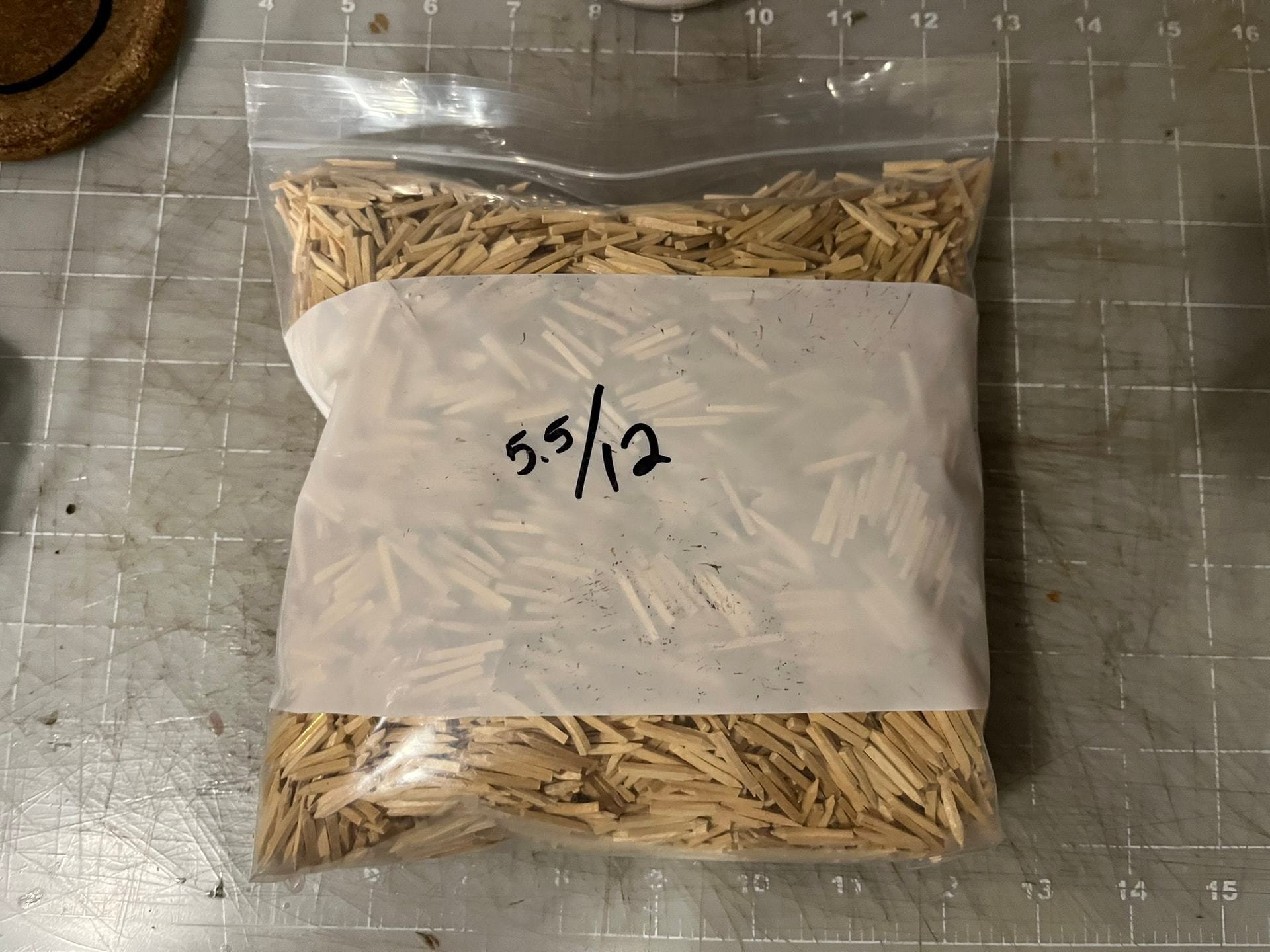
Seeing some factory made pegs also gave me a chance to double check my notes on the sizing system. Seem correct.

My impression on shape and size of the factory pegs so far is that they’re better than what I was achieving DIY, but also far from perfect. I’ll occasionally grab a peg from the bag that’s clearly undersize, oversize, or just plain irregular.

How it’s going.

Using the 40mm blades from @Customboots, I can reliably sink the thinnest 5.5/12 soling pegs, and can often get 6/11 pegs down, but have had very little luck driving the thicker 7/9 heeling pegs flush. They’re the chunkiest, so I’m least afraid to hit them hard. But they all seem to break off on me.

I wonder whether I might better set up another pegging awl with a thicker blade for heeling. Maybe one for shanking, too—match blades to pegs, by diameter.

I’ve had even more trouble than usual repairing boots, rather than making them new. In other words, anytime I try pegging on a cobbler’s anvil, rather than on a last.

I think part of the problem is that even though my old junk-find cobbler’s anvil is a set with multiple foot-shaped heads, even the largest just isn’t that large. Especially working on my own shoes, around US 13, I find myself having to push the heel of the shoe or boot up into the side of the anvil, so I’m hammering over iron.

I suspect the other issue is moisture. I can wet the surfaces of leather soles and leather heel lifts. But I don’t stand there painting or spraying on water for an hour. Even if I did, I don’t suppose I’d get the same mellow state I do laying on new outsoles I can submerge and wrap up to case. This seems to bite especially when stacking heel lifts.
This probably won’t be a helpful comment at all, but I find that when I am pegging soles, I can’t get them to work at all and then magically, I will find the right angle and I go from 1 out every 10 working to 8 out of every 10 working.

I also find that the hammer I am using makes a huge difference. Things go way better when using a smaller french hammer for some reason.

Thanks for sharing!

Everything I’ve seen and suffered says working angle means a lot, too. I suspect that’s why resoling big boots on my cobbler’s anvil goes so badly. Best case, I’m holding it tight against some side of the anvil surface. But even best case, that position’s different for different parts of the pegging line.

I’ve got an Osborne French-style hammer. Did you find a smaller one that you like?

Mine looks like a knock off of an Osborne #65. I need to replace it sooner than later since the head is a little loose.

1 Like

If you’d like to start a topic and share pictures, I bet folks here would have tips on tightening up or resetting that hammer head.

At least one of my Osborne hammers came cheap because it was wobbly. It didn’t make much more than a little wood wedge and some glue to fix it up.

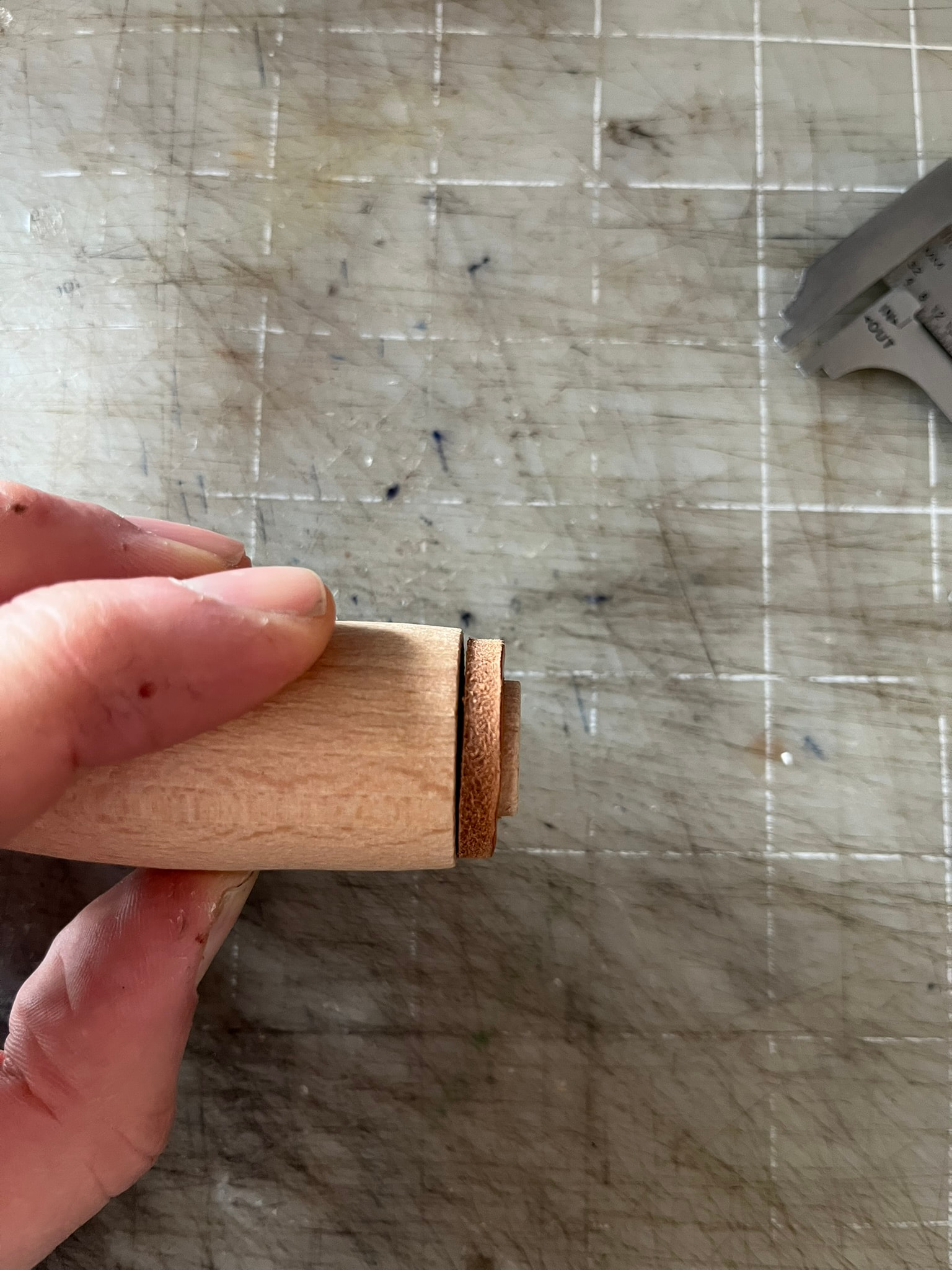
I received a package from Panhandle Leather with their pegging awl haft and blades today.

Haft


I do like the look of this haft. The two jaws just stand loose in the chuck, but I suspect they could grip a wider range of blades and needles than the Osborne haft I have.

The wood of the haft seems entirely unfinished. I’ll be adding drying oil and paste wax to mine before I use it.

I’m also going to need another leather piece for the striking pommel. The one that came with seems to have shrunk, diameter-wise and width-wise.

Awl Blades

These look for all the world like 3⁄16″ rod with short conical tips ground on the end. At $4.25 each, that’s tempting to DIY, though of course I say that as a guy with a drill driver and a file handy.

These are certainly thicker than the blades I’ve seen from @Customboots and Viktor Starko. 3⁄16″ is 0.1875″, or only a tad smaller than the nominal width of 7/5 pegs, 1⁄5″=0.2″. Maybe that’s ideal for stacking dry heel lifts.

Man, those are way different looking than the awls I have from starko. Curious how they work

1 Like

I have the same haft and awl.


I’ve only used it like 2 times on test shoes but it works ok. The round awl I got is not long enough for the 6/11 pegs I have. I measured it at 36 mm but the ferrule eats up 23 mm. I switched to a 45 mm King awl. The round awls definitely made it easier to fit the pegs, especially in cases where they are bent or dull. I can still get it to work with the King awl but I use up more pegs. The ferrule also has a tendency to come loose when I yank it out if I don’t tighten it with pliers.

1 Like

Bummer. I was worried about that.

No, the leather ring has not shrunk. It’s designed to be shorter than the wood end of the haft – wood should definitely be sticking up above the surface of the leather. When you hit the end of the pegging awl haft, the wood will split and eventually open up over the leather ring. The leather ring holds the end of the haft together and keeps the whole handle from splitting open, and the top bit folding over the leather keeps it in place so it doesn’t fall off all the time.

Leave it as it is. It’s designed that way for a reason.

1 Like

Let it mushroom over at the back. Got it. Thanks!

1 Like

I believe these are the machine awls that the late DW Frommer II sometimes mentioned he fashioned pegging awl blades out of.

It looks like @Customboots offers them as single, too. “Straight Awl” in the drop-down menu. Alas, they’re quite pricey:

Here’s a photo I found online of a box of them new old stock from a US manufacture called Torrington:

https://imgur.com/a/xVGu4

Measurements of an American Straight #6 Needle

I bought some American Straight #6 needles from Panhandle for rewelting Goodyear boots. A few sources have mentioned using broken ones for pegging awl blades, too. While I’ve got one new and unused, I thought I’d take some measurements and share them:

Total Length: 2¼″
Shank Length: ½″
Cone Length: ¼″
Hook begins ¼″ back from point.
Blade Diameter .0675″ (Nearest Fractions: 1⁄16″ = 0.0625″, 6⁄64=0.078125″ )
Shank Diameter .1125″
Shank Marking “GB 175-6”
The shank is completely cylindrical, without any flat faces.

Organ DPX17D 180/24

For comparison, here are some chunkier Organ-brand leather needles that I found in Wawak’s catalog and threw into an order:

Total Length 1¾″
Shank Length ½″
Cone and Blade Length Combined 1¼″
Blade Diameter .072″
Shank Diameter .072″ widest .067″ narrowest

So similar blade diameter at widest, but these have chisel points, sewing eyes instead of hooks, scarfs, and long grooves.

Did you get the organ needles for outsole stitching? There’s and old comment on reddit that talks about using them. Also links to a really cool Japanese blog.

1 Like

I threw the Organ needles into a Wawak order as potential pegging awl blades, hoping they were similar to American Straight needles.

You can certainly sew or stitch with a stout sewing machine needle. But I’d probably point toward something like a Speedy Stitcher for that.

Here in Oakland, I can buy Speedy Stitcher blades as separate items in ACE Hardware stores. Straight and bent versions.

For shoe sewing or stitching, I’d personally strongly prefer one of the McKay or American style needles, with the open hook, over the more typical sewing machine needle with a scarf and groove.

The ever generous @Customboots was kind enough to answer some questions from Gitty, my local shoe friend, and I.

I was able to update my notes on peg sizing with more detail on what @Customboots uses where:

  • 5.5/12 to fasten upper to the insole after lasting, but clipped to about two thirds of their length
  • 6/11 to fasten outsole to insole, through the shank and around the heel seat
  • 7/9 to stack heel lifts
  • Lisa aims to pierce pegs only into the insoles, not into the lasts, to avoid trouble delasting.

She also mentioned that she uses different blades than the 40mm round ones she sells for stacking heels, and also that she’ll be getting some new, more specialized blades for sale soon. She described them as “oval with a spoon shaped end”.

1 Like

I need to try some 6/11s here soon. Been using 5.5/12s for probably more than I should.

1 Like

Gitty and I both remarked how close 5.5/12s are to 6/11s. We thought we could tell a little difference in setting them, but we both agreed you could probably make good boots with one or the other.

I suppose I could swing for the fence and go with the 7s. I’d like something a little more substantial for doing the waist than the 5.5s I am currently using.

1 Like

For Blau Ring, the first number is length in eights and the second is width as a fraction of an inch. So the 7/9s are much thicker than the 5.5/12s or 6/11s. https://shoemaking.wiki/American_Shoe_Peg_Sizing#dimensions I’m still trying to find a wider blade for setting 7/9s.