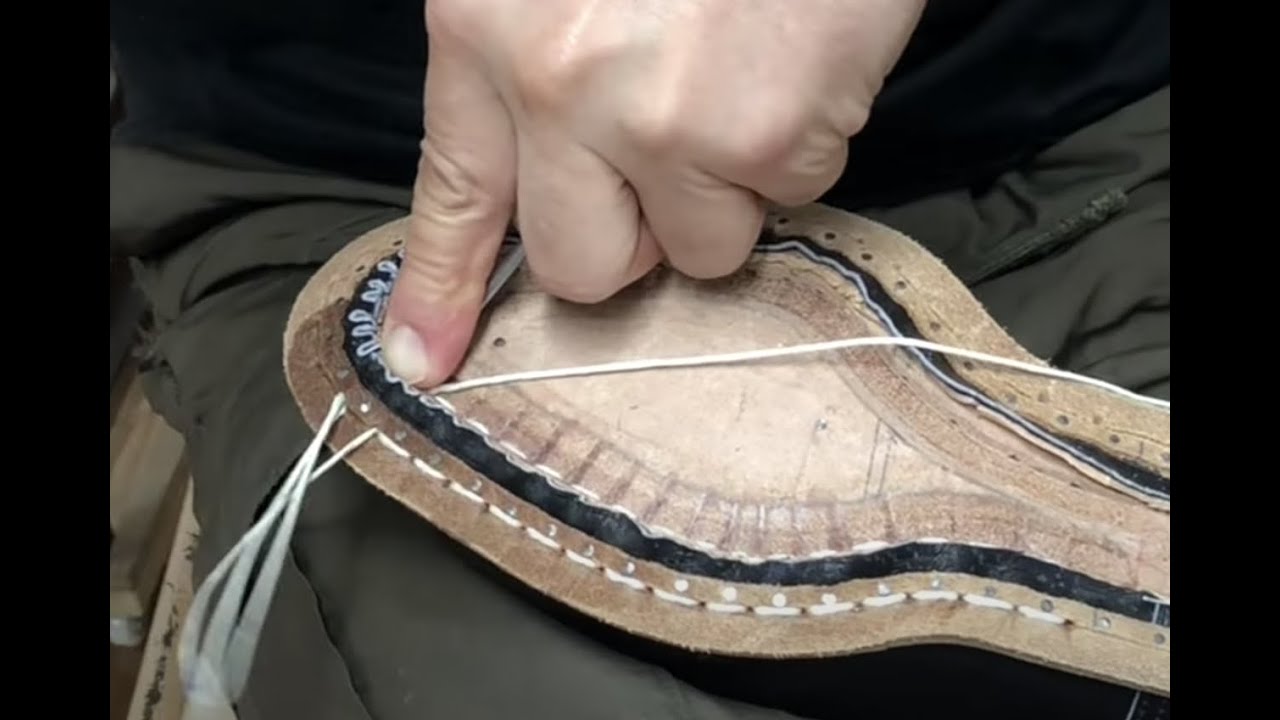
Lisa Sorrell managed to get the German-made wood pegs back in stock after a supply scare, but I’ve been thinking about alternatives, especially since finding this Kazuma Nishimura video where he pegs a welt through the waist and heel with bamboo toothpicks:
Really clean work, by the way. Great video.
My big takeaways in the journey so far:
European shoe pegs are usually made of birch. This is true even of the pegs used by cowboy boot makers, many of whom traditionally refer to the pegs as “lemonwood”.
There are various sizes, but the most popular are a little over 2mm for soles and a little under 3mm for stacking heels. All are less than one inch long.
It’s no big deal to trim pegs to length with cobbler’s pincers or a hobby-scale razor saw. Plus, you can match the peg length to the length of your awl blade you expose before the bumper that way.
The bamboo toothpicks like Kazuma’s that I could find can absolutely work, but they’re a little on the thin side at 2mm. I also found better success tapping them in with two or three moderate blows, rather than driving home in one, hard blow like birch pegs.
Looking around on the market, I found some sources saying that mass-produced toothpicks from American brands are usually birch wood, though unlabeled. Most toothpicks of this style seem to be round, but Diamond offers some square-shanked ones:
I e-mailed Diamond yesterday and got clarification today that theirs are, in fact, birch. Also that their nominal flat-to-flat width is 0.02cm, or 2mm, just like the round bamboo toothpicks I tried. So still a little narrow.
I’m not sure this is a dead end yet. Many of these culinary supply companies also offer “skewers” for barbecue that are thicker. I’ve seen multiple webpages from B2B manufacturing firms offering birch skewers in 2.5mm width, at basically whatever length you like. I haven’t yet found the magic search terms for how those get sold on the consumer market. If I could find some 2.5 to 2.8mm wide, I suspect I’d be set for my needs.
It looks like at least some of these products are originally manufactured by a firm called by Spikomat in Sutton on Trent in the East Midlands of England:
3/32 is about 2.4mm, so a little thinner than the pegs cowboy boot makers seem to be using now. 3.5mm is much wider. I was shooting for 2.5mm. The nearest clean fractional inch is 1/10, but you hardly ever see that.
I’ve seen product listings for 2.5mm bamboo skewers of various kinds. But I’m holding out hope for a hardwood option.
You can find those Blau Rings on some European sites. Kinda hard to get unless you use a proxy, but they are cheap too. Like 7-9 Euros per pound box. The Japanese also manufacture pegs, also a little tricky to track down, but they are still made fwiw.
I always assumed they were actually European lemonwood like people say they are, didn’t know they were birch. Makes sense given the times we live in.
Interesting thing I saw on Youtube was where a Japanese maker was toasting his pegs in a frypan over the stove, right before use. Presumably to give them a bit of shrinkage before putting them in (where they’d thereby swell back to size)
They’re always called lemonwood, but as far as I can tell, it’s just birch.
That is interesting! Do share if you remember where you saw it.
The word I’ve heard on various preps and treatments for pegging has been all over the place.
Some folks apparently put glue or cement on their pegs before driving in, but some makers and repair folks have done without for years and never seen a peg feel, even on working cowboy boots.
A lot of folks recommend casing or otherwise moistening outsoles and heel lifts before pegging. That would make it easier to drive the pegging awl, but also tend to swell the leather.
I’ve been wondering myself whether it wouldn’t be worth hardening pegs with shellac or something similar, either before pegging or by dotting their exposed tops once drive in. Since the grain runs parallel to the long axis of the pegs, there’s an opportunity to soak something in partway down from the top.
I’m reassured, because they’re about as ugly as the ones I’ve been making at home.
There’s a YouTube video showing the machines he’s using.
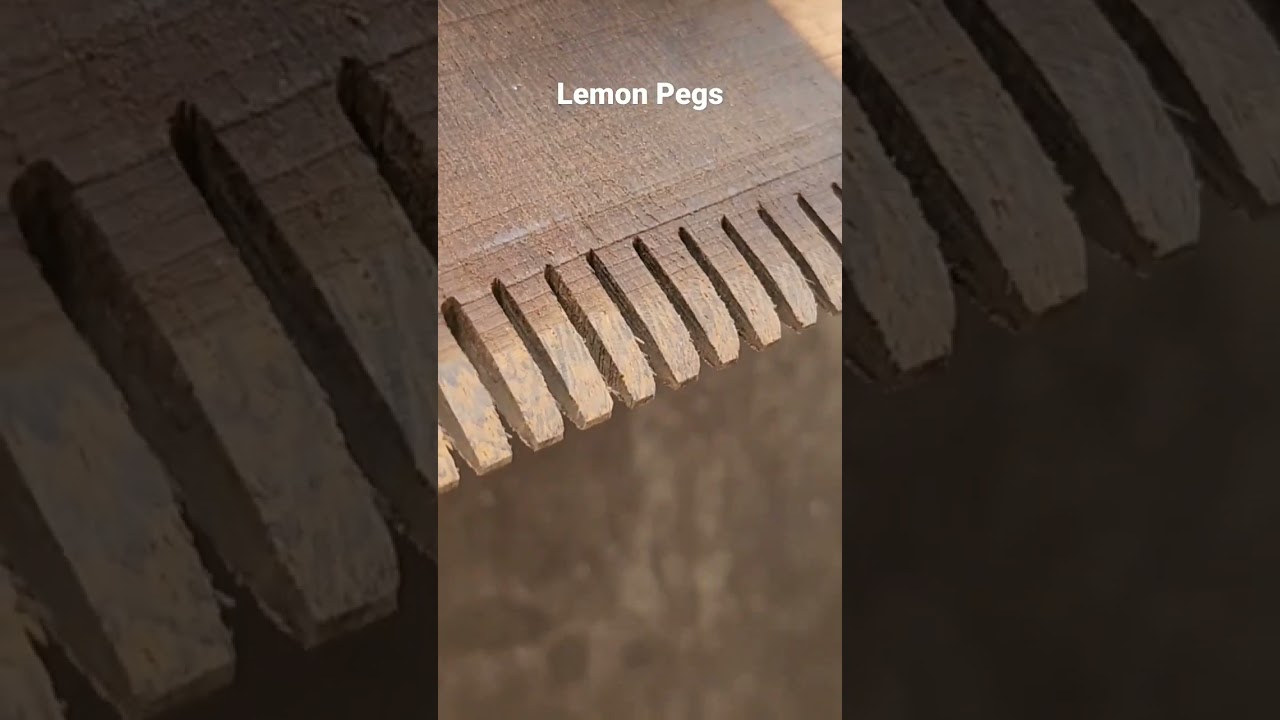
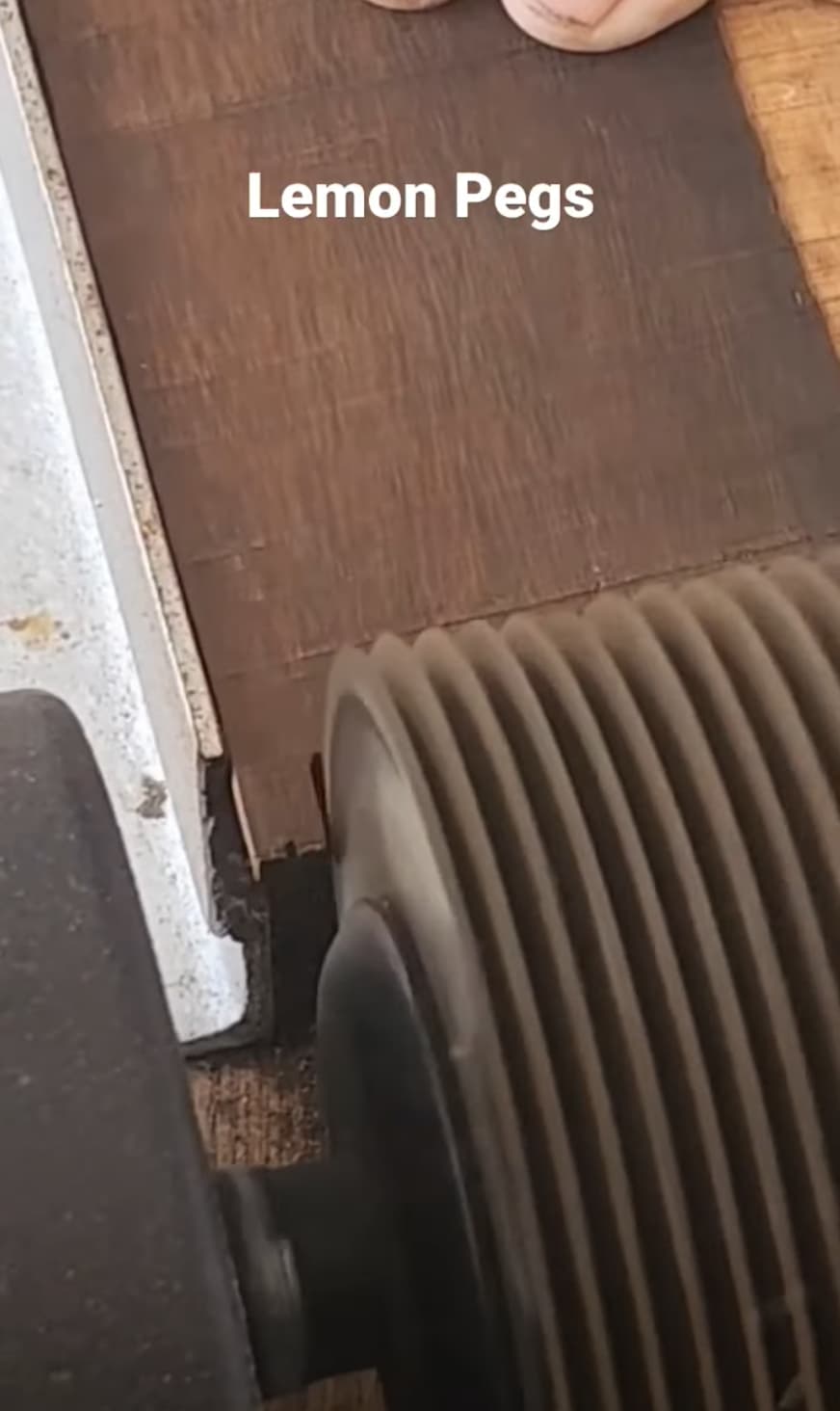
It’s only shown briefly, but he’s got a tool or a jig with a bunch of circular saw blades spaced at intervals to cut a bunch at once. It looks like it might be mounted on a bench grinder or the end of a finishing machine.
I sent a question to Chef Craft, who sell brich skewers for BBQ in two different lengths.
Asked:
How wide are Chef Craft’s birch-wood BBQ skewers? Somewhat thicker in diameter than a toothpick would be ideal for my application. Around 2.5mm, perhaps.
Response:
Yeah, the birchwood ones are pretty small. Probably pretty close between 2-3mm.
I ordered some of the 2.4mm basswood to play around with I’ll share how it goes. If my math is right and it rarely is it should be between the 1/11” and 1/9” wide pegs
Haven’t decided how I’ll point them yet but tempted to start with alternate cuts like this
==/==|==/==|==/==
And just see how pegs like this
==
will behave
Edit - yah that math is wrong anyway 1/11 is 3/33 right? So pretty close
I received a pack of Chef Craft brand 10-inch birch ¨BBQ Skewers" today.
These are round, not square. But all the ones I’ve measured so far came in between 2 and 3 mm in diameter, right in the the ballpark of Blau Ring /11 and /9 pegs’ flat-to-flat measures.
These skewers are noticeably thicker than the 2mm-ish Asian-style bamboo toothpicks I tried earlier. The wood grain runs consistently lengthwise, with only one or two in the pack with visible tearout.
For specificity, the product I got was marked with item number 20936 and UPC 085455209369. The hanger tab reads:
100 Pc. - Smooth Birch
10 Inches Long
Manufactured for Chef Craft Corporation
Pewaukee, WI
Made in China JT-A
I also did a little reading up on matchsticks. My takeaway was that better wooden matchsticks are often made to 2.5mm flat-to-flat in width, which would suit. But also that they’re usually soaked with flame retardant chemicals, which may not be great for leather and shoes. If anything, the wood standards seem to be even lower than for toothpicks.
I might keep looking into tools for making matchsticks, since they’re probably the closest synonym for “shoe peg” from what’s commonly available, in physical wood-stick-this-shape terms. But I don’t think I’m going to be begging or buying any more matches as candidates for whittling into pegs. The culinary products are way more promising.
I dropped by MacBeath Hardwood in Berkeley today. I poked around all the veneers and “hobby board” hardwood they had in shop, but didn’t find anything 3/32 inch thick, the closest common fractional thickness to 5½/12 and 6/11 pegs.
I asked the fellas at the counter, who tend to know a thing or two, if they know of any hardwood sheet goods at 3/32" thick. They said they don’t now, though they used to sell some things that were close. Apparently cladding wood projects with thicker 1/8" veneers used to be more in vogue, but hasn’t been for a while. They no longer carry those products, or even hear about them.
Digging around online, other outlets do seem to have 1/8" boards:
The magic search term is “thin stock”.
For those with access to a wood planer, perhaps the easiest method of all would be to buy some thin stock hardwood, plane it down to between 2 and 3 mm, crosscut into strips, notch out triangular points, and split between the points. You’d end up with pegs that have two opposite faces flat and parallel and the other two opposite faces irregular, following the grain.
Upshot: I suspect these will do many people fine as soling pegs, especially those with thinner pegging awls and those who dip their pegs in glue. You just have to cut them in half and to length.
The bad news is that they are indeed a little on the thin side. I measured the flat-to-flat width of a handful, and they all came in at 2 mm. That makes them practically equivalent to /13 pegs and just 0.1 mm skinnier than /12 pegs.
For anyone searching later, I measure:
65 mm long tip-to-tip, or roughly 21/2 inches
2 mm wide flat-to-flat, or roughly 1/13 inch
points 10 mm long on each end, or a tad longer than 3/8 inch
Per Diamond’s customer support e-mail to me, they are in fact birchwood.
My only lingering question is whether the longer taper to the points will have any negative effect. Pro: less wood sticking past the insole and into the last might be a good thing. Con: potentially less contact surface area, and therefore less grip, inside the insole, especially if you pierce or drive a bit shallow.
The tips are tapered so consistently that you could clip them short and still have a perfectly usable point thin enough to sit upright at the top of a pierced hole. But that is an extra step.
Man, I’m sorry that happened. I know it can be frustrating.
I came around to seeing the positive in it when I realized it was the universe saying both “your pegging could maybe use some work” and “here’s an opportunity for more bottoming practice” at the same time. But still, I feel for you.
Am I seeing clinch nails from the outsole that didn’t clinch through the heel seat there? Some of the tips look bent, but some still look straight.
These are kimmels so i dont feel any responsibility for them but yeah it looks like they nailed the heels. Theres a plastic rand which i cant imagine glues as good as leather, i wonder if thats any part of it. Also the outsole appears and feels pretty dry, i wonder if theres some shinkahe of the leather aroubd the holes that happens at this age, i think about 20-40 years based on when the elder kimmels were working

 anyway 1/11 is 3/33 right? So pretty close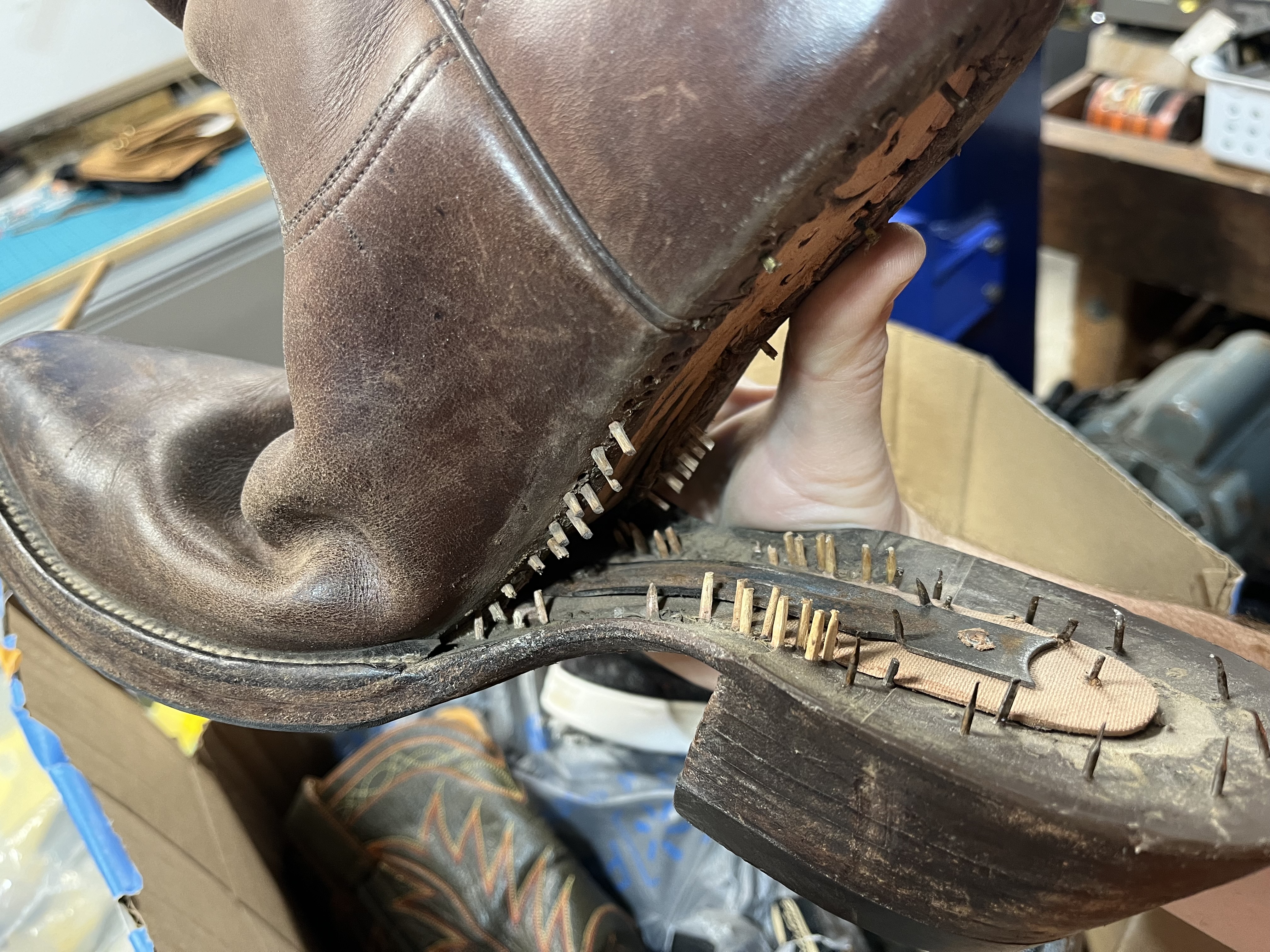
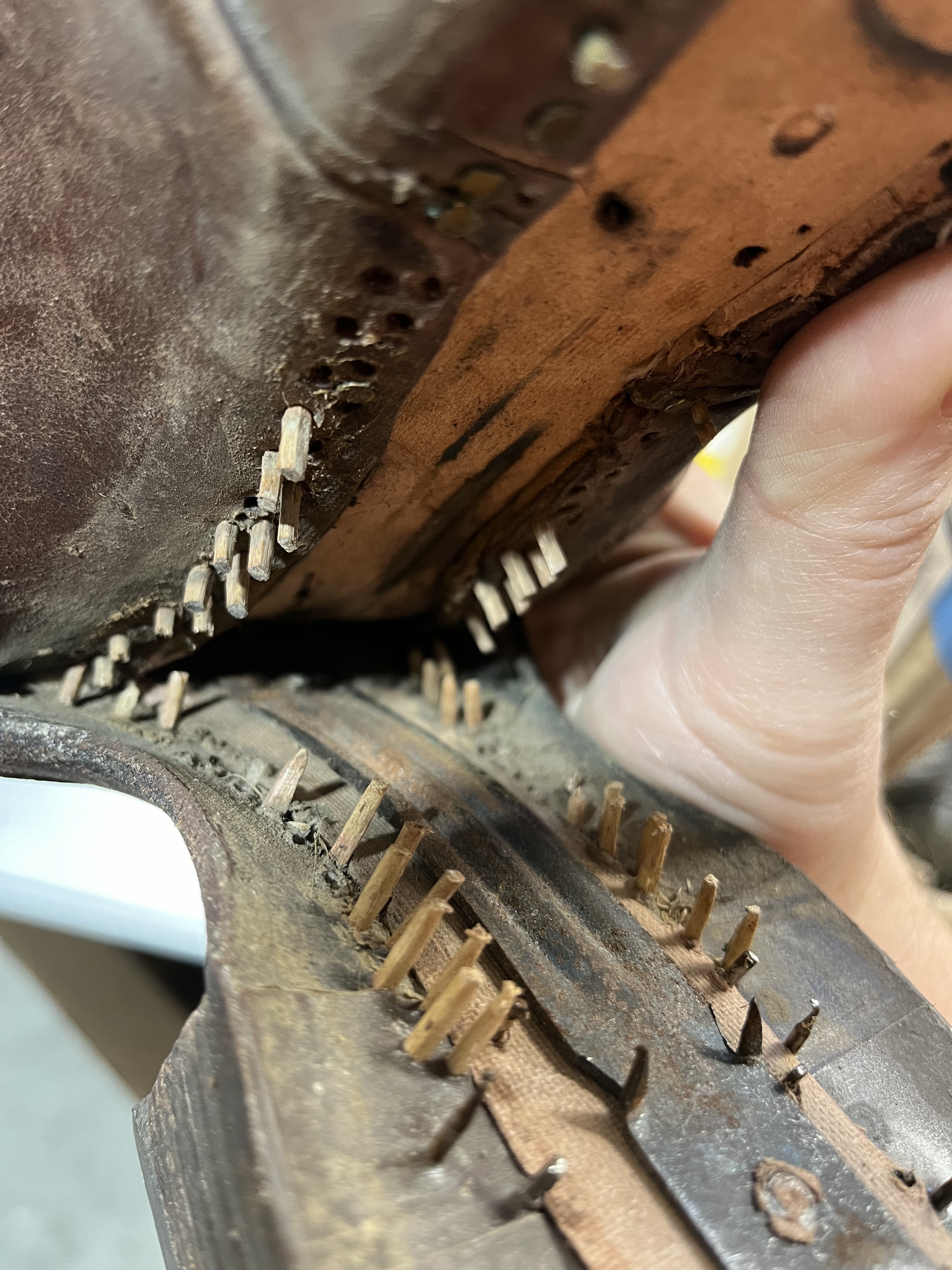
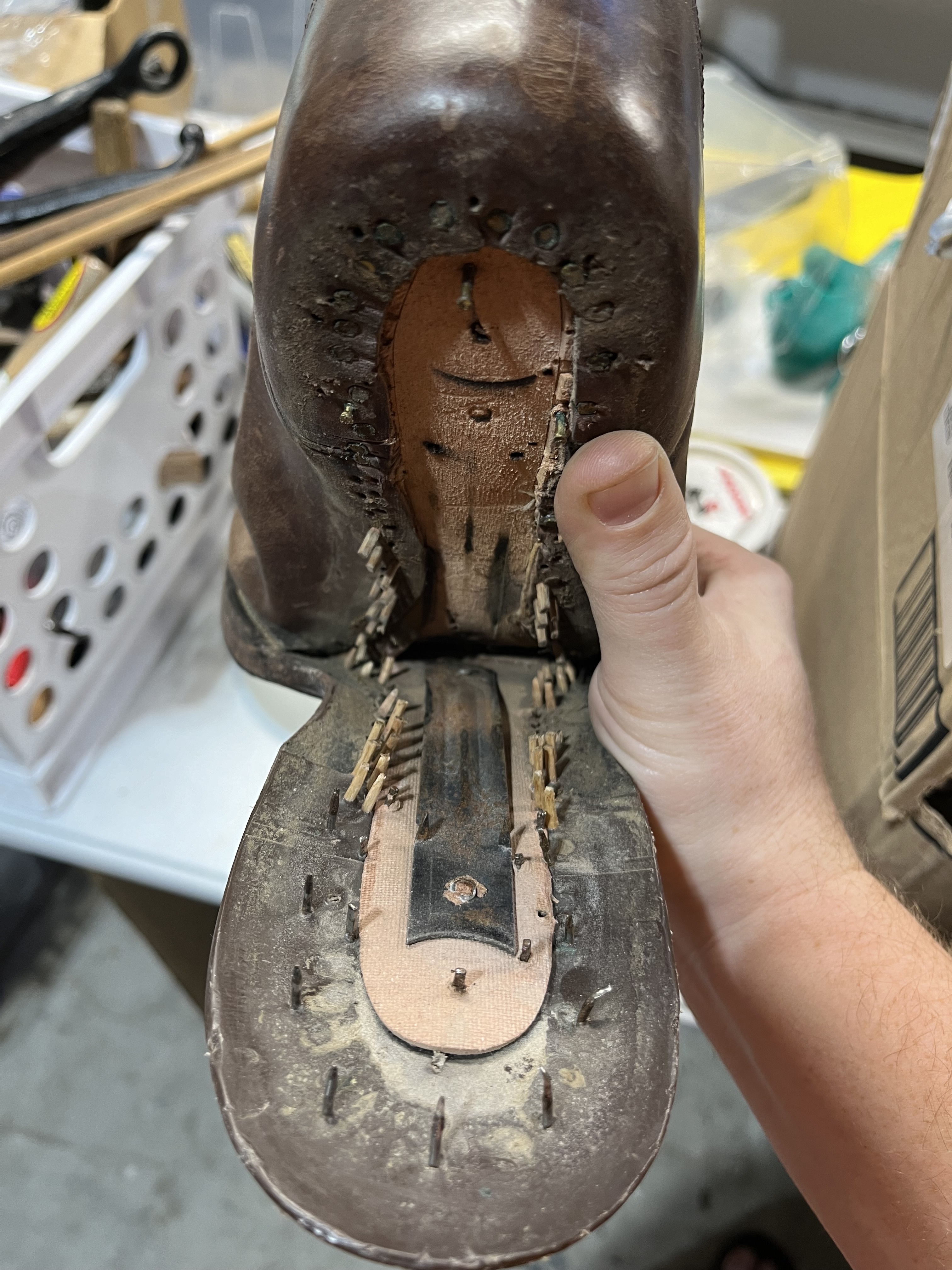
 but yeah it looks like they nailed the heels. Theres a plastic rand which i cant imagine glues as good as leather, i wonder if thats any part of it. Also the outsole appears and feels pretty dry, i wonder if theres some shinkahe of the leather aroubd the holes that happens at this age, i think about 20-40 years based on when the elder kimmels were working